Snowball Earth continues its uneven but occasionally thrilling trek through episodes 8 and 9, juggling big set-piece confrontations, character beats, and a frustrating inconsistency in animation quality. These installments push the survivors toward an inevitable clash with Sagami and his forces while giving us flashes of genuine visual ambition — if only the series committed to them more often.
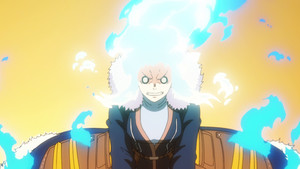
Table of Contents
Episodes 8–9: Tension, Trajectory, and the Build-Up to a Big Showdown
These episodes focus on escalation rather than catharsis. After Yukio suffers another brutal beating at the hands of the kaiju, Sagami’s squad closes in on the survivors’ hideout — a school building repeatedly referenced as a “mall,” which, while odd, helps sell the apocalypse-as-public-space vibe. The survivors’ last line of defense is a protective barrier created by Hagane’s deceased mother, and watching Sagami’s monsters batter that barrier delivers steady, suspenseful pacing.
Good Pacing, But Postponed Payoff
The series is careful to stretch tension across these two episodes, which works in terms of anticipation but can frustrate viewers waiting for a decisive, sprawling kaiju showdown. Instead of landing a long airborne duel or a single epic confrontation, the show intersperses fights with flashbacks and quieter character moments. That breathing room can be welcome, but when fight sequences are chopped up repeatedly, it creates narrative dissonance and dampens the impact of the action.
Animation Analysis: CG Problems vs. 2D Sakuga Moments
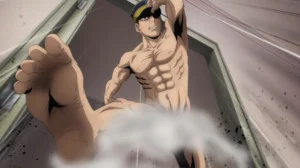
One of Snowball Earth’s most persistent talking points remains its animation. The show leans heavily on CG for kaiju and large-scale movement, and the results are often awkward. Certain motions — like a bat-like kaiju stomping on the barrier — read as stiff and oddly childlike rather than threatening. Even unique kaiju designs, such as antlered beasts that spawn smaller projectile-like minions, can look off when rendered in inconsistent CG.
The Few, Brilliant 2D Shots
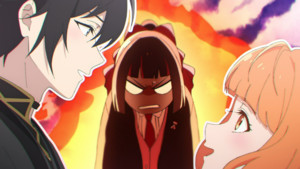
Yet episodes 8 and 9 also give us some of the show’s best-looking moments in pure 2D. Ao’s fiery showdown on top of her chicken kaiju is visually electrifying: bright orange flames, thickened outlines for dramatic emphasis, and an intensity that reads like classic sakuga. A mid-episode firestorm sequence in episode 9 delivers a satisfying burst of hand-drawn choreography that obliterates an opponent with visceral force. Those sequences showcase the potential of this world when the animators lean into traditional 2D energy.
Inconsistency Hurts the Experience
Unfortunately, the contrast between the 2D highlights and the clunky CG makes the latter feel worse by comparison. Rather than a unified visual vocabulary, Snowball Earth feels like a compilation of conflicting styles. The occasional sakuga-tease raises expectations, and then the series reverses course with another awkward CG set-piece. This unevenness makes the show feel like it’s teasing viewers with what it could be instead of committing to a consistent aesthetic.
Character Focus: Yukio, Ao, and Sagami
Yukio continues to take beating after beating, yet he still rises again — part Rocky Balboa, part narrative repetition. His recurring decimation raises questions about pacing and character stakes: is this resilience meant to be inspiring, or are we trapped in a loop of punishment that undermines tension?
Ao’s Moment to Shine
Ao fares better. Her climactic presence astride a burning kaiju provides one of the season’s more memorable hero moments. It’s the sort of dramatic tableau that works emotionally and visually, especially in 2D. Ao’s sequences energize the episode and give viewers a character to root for when the narrative stalls elsewhere.
Sagami: A Misfire of Villainy
Sagami’s arc is the weakest element here. His plan — slaughtering those who don’t support him in order to save them — is presented as villainous, but the show struggles to make his motivations compelling or credible. Flashbacks intended to elicit sympathy instead highlight plot conveniences and poor logic: how a high-ranking, ambitious soldier with a psychotic streak gets unquestioning approval for a plan so obviously self-destructive strains belief. Rather than adding depth, these sequences make his character and the world around him feel less grounded.
Battle Choreography: Promises vs. Delivery
Several fights in these episodes are promising on paper, especially the airborne clash between Ao’s mount and the bat kaiju. In practice, those sequences are too brief or interrupted by flashbacks and exposition to fully deliver. The editing choice to punctuate fights with long interludes undercuts momentum. When the show does focus on a full, uninterrupted fight — particularly in 2D — it can be excellent. The problem is that those moments are rare.
Where Snowball Earth Excels and Where It Stumbles
Strengths:
- Moments of genuine sakuga and striking 2D imagery (Ao’s fire sequences).
- Good tension and atmosphere as the survivors brace for a major assault.
- Ambitious kaiju designs that, when animated well, are visually compelling.
Weaknesses:
- Inconsistent animation quality — jarring shifts between CG and 2D.
- Villain motivations and logic that feel blunt and paper-thin.
- Chopped-up fight sequences that reduce narrative and visceral impact.
Where to Watch
Snowball Earth is available to stream on Crunchyroll. For those interested in learning more about sakuga and why hand-drawn moments can have such a different emotional effect than CG, see this article on sakuga (Wikipedia) for context: Sakuga — Wikipedia. You can watch the series here: Snowball Earth on Crunchyroll.
Final thoughts
Episodes 8 and 9 of Snowball Earth are a study in contrasts: high-quality 2D bursts of brilliance versus frequently awkward CG, taut setup vs. postponed payoff, and intriguing character glimpses overshadowed by sloppy villain logic. If the series can commit to more of the hand-drawn intensity that shines in Ao’s scenes — and tighten its fight editing and antagonist writing — it could become a much more compelling ride. For now, it’s a mixed bag: frustrating at times, but still capable of delivering moments that make you eager for more.