Snowball Earth’s fourth episode continues to juggle a high-concept premise — an icebound Earth overrun by kaiju — with uneven execution. This installment dials back the overt CG in a few scenes and leans into quieter character beats, but the series still struggles to balance spectacle with emotional payoff. There are flashes of genuine chemistry between Tetsuo and new survivor Ao, and the mall-set refuge hints at intriguing survival-horror possibilities. However, clumsy flashback sequencing and anti-climactic CG choices keep the episode from fully delivering on its potential.
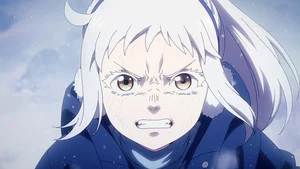
Table of Contents
Animation and CG: A Mixed Bag
One of the biggest ongoing discussions around Snowball Earth is how it handles CGI versus traditional 2D animation. This episode is an improvement in that the CG is less dominant than in the previous installment; when 2D is used, the animation generally looks cleaner and more detailed. Scenes that rely on hand-drawn touches — particularly emotional close-ups and quieter interactions — benefit from that warmth.
That said, CG still accounts for a large portion of the episode, and its deployment is inconsistent. The most frustrating choice is how some potentially spectacular kaiju encounters are deflated by last-minute CG transitions or editorial decisions that undercut the tension. A climactic moment that might have been an all-2D showcase instead lands with less impact because the animation style shifts and the sequencing prioritizes convenience over spectacle.
When the 2D Works
Flashbacks and intimate scenes are where Snowball Earth shows real visual promise. Facial expressions, subtle gestures, and small human beats come through more effectively when the animators lean on 2D techniques. These moments are easier on the eyes and help ground the narrative even when the larger CG-heavy sequences falter.
When the CG Fails to Deliver
Action sequences that rely heavily on CG can feel stiff or tonally dissonant compared to the 2D moments. One particularly jarring example is a scene where Ao appears to catalyze a kaiju fight — the payoff, which should be dramatic and cathartic, is flattened by awkward CG and an anti-climactic resolution. For a series whose concept thrives on monster spectacle, effective choreography and consistent visual language are essential, and the episode still has not found a stable middle ground.
Ao and Tetsuo: Slow-Burn Chemistry
Introducing Ao as a more fully-drawn character is one of this episode’s strengths. Previously a background survivor, Ao now gets a violable arc and a clearer role: a kaiju tamer with a closed-off personality who mirrors Tetsuo’s own communication struggles. Their awkward exchange over a shared pineapple is simple but sweet, and the show uses their mutual social anxiety to create a believable, adorkable connection.
This pairing works because it doesn’t try to rush intimacy. Both characters’ stilted communication feels authentic rather than forced, and their quiet bond is the episode’s emotional anchor. It’s an effective contrast to the large-scale threats around them: while the world freezes over and monsters roam, Ao and Tetsuo’s small human moments feel important and earned.
Flashbacks and Worldbuilding: Promising Premise, Sloppy Payoff
The episode attempts to deepen the series’ backstory by showing how a kaiju rising from the ocean triggered the glaciation that froze Earth. This is a promising direction for worldbuilding — blending ecological horror with kaiju mythology — but the flashback execution undermines the reveal.
Ao’s survival story is dramatic on paper: starvation, desperate choices, and an apparent miracle that turns her into a symbol for her group. But the scene that’s meant to establish her as a pivotal figure — a confrontation between two massive creatures — is resolved too quickly and in a way that feels narratively cheap. Instead of a tense, cinematic showdown, the fight is cut short by a sudden ko, and Ao gains powers in a contrived “love-and-friendship” moment. The result is anticlimactic; a sequence that should have showcased the series’ monster choreography ends up feeling like a missed opportunity.
Pacing and Exposition
Another issue is pacing: the episode crams a lot of exposition into idyllic flashbacks and then rushes back to present-day action. That mismatch dilutes both the emotional resonance of Ao’s past and the urgency of the current threats. If Snowball Earth wants to deepen its lore, it should slow down the reveal and let big beats breathe instead of resolving them off-screen or with tonal whiplash.
Mall Refuge: Dawn of the Dead Energy
One of the more intriguing ideas introduced here is the mall as a makeshift survivor haven. This setting evokes classic survival-horror motifs — think small communities carving out a fragile normalcy amid broader collapse. The mall’s potential for sustained drama (inter-group politics, scarce resources, claustrophobic tensions) is strong, and it could allow the show to borrow effective tropes from zombie and disaster genres.
Visually and thematically, the mall offers contrast to the frozen wilderness outside: a place of human order and commerce turned sanctuary, full of people trying to reclaim safety. If the series leans into this and pairs it with tighter animation choices during key action scenes, it could find a richer balance between character drama and kaiju spectacle.
Where the Series Should Improve
- Commit to a visual strategy: either integrate CG more seamlessly with 2D or reserve CG for set-pieces that actually benefit from it, rather than patching over important moments.
- Pace flashbacks more carefully to preserve emotional weight. Let major reveals have proper build-up and payoff.
- Develop survivor-settlement dynamics in the mall as a sustained narrative thread — it’s one of the most promising directions for the show’s worldbuilding.
- Maintain consistent tonal stakes: if a scene feels life-or-death, don’t undercut it with a sudden, offscreen resolution.
Snowball Earth is currently streaming on Crunchyroll.
Final thoughts
Episode 4 of Snowball Earth gives viewers a clearer sense of who Ao and Tetsuo are and plants intriguing seeds — the mall refuge, survivor politics, and the larger kaiju mythology — that could pay off later. Unfortunately, inconsistent CG choices and rushed flashbacks keep the episode from being the standout it could have been. If the series tightens its visual approach and allows emotional and monster beats to land with more care, it still has the ingredients for something memorable. For now, it’s a mix of promising ideas and uneven execution that’s worth watching for the character moments, even if the spectacle occasionally disappoints.