The Warrior Princess and the Barbaric King continues to surprise — not always in the best ways, but often in ways that keep you watching. Episodes 9 and 10 push the show beyond its established comfort zone: there’s a hot spring moment, awkward continuity choices, and some genuine attempts at character growth for Sera and Veor. In this review I break down the highs and lows of both episodes, examine how the series handles humor and worldbuilding, and explain why episode 10 ultimately feels like the stronger installment.
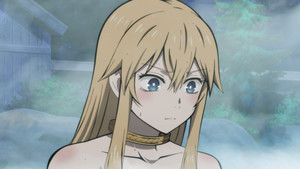
Table of Contents
Episodes 9–10: A Brief Overview
Episodes 9 and 10 attempt to do two things at once: deepen the central romance between Sera and Veor, and expand the scope of the world beyond Sera’s Illdoran-centric worldview. Episode 9 leans more into the protagonist’s internal conflict—her loyalty to Illdora versus the pull she feels toward a future with Veor—while episode 10 injects more movement and discovery, culminating in a classic anime hot spring scene that the show treats as both gag and character moment.
The Hot Spring Scene and Comic Timing
Hot spring episodes are practically a genre staple, and this series delivers one that is symptomatic of its broader tonal inconsistency. The scene aims for an awkwardly funny beat: Sera appears composed, then suddenly exposes herself in a way that flusters Veor. The execution, however, stumbles on continuity. Visual cues that should build the joke—where Sera was sitting before Veor arrived, or how her position changes—are either missing or portrayed inconsistently. The result is humor that feels half-baked: you understand the intended punchline, but the setup isn’t convincing enough to land it fully.
Why the gag falters
Part of the problem is trust. The show seems unsure whether the audience will accept a subtle lead-up, so it overcompensates by showing exactly what it thinks we need to see for the joke to work. That lack of subtlety robs the scene of potential charm and reduces character agency in favor of a cheap laugh. Yet even in that misstep, episode 10 manages to offer something: a glimpse at Sera’s vulnerability and a show of Veor’s honest, unpretentious reaction, which helps keep the scene grounded despite its flaws.
Character Growth: Sera and Veor
The core of these episodes is Sera’s emotional tug-of-war. Raised with a rigid notion of Illdorians and barbarians as diametrically opposed categories, she must reckon with the reality that the “barbarians” are people with their own customs, virtues, and complexities. Veor’s gentle nudges toward broader horizons are among the show’s best moments—small gestures that suggest he genuinely sees Sera rather than the image she presents to the world.
Sera’s cultural blindspots
Sera’s growth isn’t instantaneous, and the show handles that unevenly. She still falls into stereotypical assumptions—particularly when encountering dwarf characters—and her defenses occasionally feel like regression rather than development. However, she shows a willingness to revise her beliefs when confronted with new evidence. That willingness is crucial: it’s what makes her trajectory believable even when the narrative convenience of “he’s there and he’s attractive” threatens to flatten her emotional arc.
Veor’s subtle support
Veor’s approach is refreshingly low-key. Rather than grand declarations, he offers quiet encouragement and concrete suggestions—like urging Sera to travel and see more of the world. Those moments are effective because they reveal a partner who believes in Sera’s capacity to change without guilting her into it. The show still needs to provide clearer motivation for why Sera reciprocates romantically beyond physical attraction, but Veor’s empathy goes a long way toward making their bond feel plausible.
Worldbuilding: Expansion and Open Questions
Episode 10 is where the series earns points for exploration. By taking Sera outside familiar settings, the anime broadens its palette: different tribal customs, new landscapes, and encounters that challenge Illdoran-centric myths. That said, the worldbuilding raises as many questions as it answers. For example, Sera has killed a spirit dragon earlier in the story—does that imply she should have the ability to summon or control similar spirits? The show touches on mystical mechanics but often leaves threads dangling, which can be intriguing or frustrating depending on how much closure you expect from a mid-season episode.
These episodes balance exposition with character beats, but a firmer commitment to explaining lore details would make the stakes feel larger and more satisfying. As it stands, the world feels rich in potential even if the series isn’t always willing to fully follow through.
Episode Comparison: Which Episode Stands Out?
If you’re deciding which episode most effectively advances the series, episode 10 has the edge. It’s more entertaining, pushes Sera into new emotional territory, and uses its set pieces—awkward comedy aside—to expand the narrative canvas. Episode 9 does the heavy lifting on internal conflict, but its pacing lags and it sometimes reiterates themes without deepening them. Taken together, the two episodes form a solid one-two punch: 9 sets up the personal stakes, and 10 delivers the payoff in the form of discovery and character interplay.
Where the series can improve
Overall, the show would benefit from cleaner continuity in comedic beats, clearer motivations for romantic development, and sharper handling of its mystical rules. When those elements align, the series shows real promise: moments of genuine tenderness and intriguing worldbuilding peek through the rougher edges.
Warrior Princess and the Barbaric King is available to stream on Crunchyroll. For additional episode details and fan reactions, see its entry on MyAnimeList.
Final thoughts
Episodes 9 and 10 of The Warrior Princess and the Barbaric King are emblematic of the series as a whole: uneven but often compelling. Episode 9 wrestles with Sera’s identity and loyalty, while episode 10 opens the door to a broader world and more effective character moments. The show rarely coasts—it frequently stumbles toward something interesting. If the series can smooth out its comedic timing and tighten its lore, future episodes could turn promising threads into a satisfying tapestry. For now, these episodes are worth watching for the character beats and the worldbuilding momentum they create, even if the execution isn’t flawless.