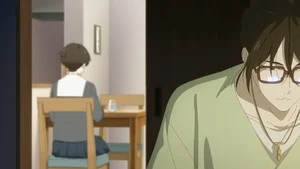
Journal with Witch episode 7 leans into shadow—in both literal and emotional ways—unspooling scenes of quiet dread, tender confessions, and slow-burning revelations. Where previous installments toyed with the tactile electricity of infatuation, this episode makes darkness its central motif: voids that swallow characters whole, longings that are unspoken, and expectations that corrode relationships. The adaptation flexes its strengths here, pairing intimate character work with visual language that underscores the isolation each figure feels.

Table of Contents
Episode overview: tone, structure, and striking imagery
Episode 7 plays like a study in contrasts — restaurant conversations edited together to suggest thematic echoes, bright moments of human connection undercut by sudden, pitch-black visual choices. Several key scenes transpose internal darkness into the frame itself: characters stand inside literal black voids, rooms are rendered almost entirely dark, and memory sequences fold into one another with a dreamlike, unsettling logic. The episode’s structure smartly interweaves multiple pairings (Makio with Michiko, Kasamachi with Daigo, Asa with Emiri), letting small overlaps and mirrored beats build a coherent emotional argument.
Exploring darkness and mental health in Journal with Witch
The show treats mental health matters with surprising frankness for the medium. Kasamachi’s arc is one of the episode’s most affecting elements: an adult man articulating shame, helplessness, and the stubborn voice that scolds him for not living up to masculine expectations. His admission to Daigo — about feeling weak and the pressure to “get over it” — cuts through cultural prescriptions and shows how those norms can isolate people who just need connection and understanding. The series doesn’t dramatize his pain for shock value; it renders it as everyday thought patterns that many viewers will recognize.
Minori and the burden of “normal”
Minori’s storyline digs into the corrosive idea of normalcy. Seen through the eyes of others this week—particularly Michiko—her judgmental posture is reframed as an attempt to police herself. Minori internalized a script of what a woman should be: marry, bear children, conform. Those expectations eroded her friendships and made her unable to accept help. The episode’s use of memory and spectral imagery underscores how Minori’s attempts to cast herself as “normal” were defensive incantations that ultimately pushed away potential lifelines, including Makio’s more flexible, nontraditional approach to life.
Kasamachi: masculinity, shame, and the slow work of unlearning
It’s especially notable to see an anime address male vulnerability in a way that doesn’t reduce it to stoic suffering or comic relief. Kasamachi’s inner monologue reveals a lifetime of handed-down expectations — be stoic, be the “good son,” don’t burden others — and the episode allows viewers to witness the fear of judgment that persists even after recovery begins. His conversation with Daigo provides a crucial counterpoint: friendship that listens without shaming. For many viewers raised in environments that discouraged emotional honesty, Kasamachi’s presence can feel like validation that those scripts can be questioned and changed.
Emiri’s quiet coming out: subtle direction and empathetic framing
Emiri’s angle is handled with rare subtlety. The episode gives us small, crystallized moments — her tearful memory of watching Fried Green Tomatoes, her distracted stare when Asa jokes about girlfriends — that quietly signal an internal shift. The camera work favors her point of view, inviting empathy rather than spectacle. Asa’s reactions are worth noting, too: they’re not malicious so much as a reflection of background-level assumptions that make it harder for someone to come out. Emiri’s vulnerability is treated respectfully, and the animation lets her emotional interiority breathe.
Adaptation choices that elevate the material
Several stylistic choices lift the episode. The seamless editing between two restaurant scenes encourages the audience to read parallels and double meanings across conversations. Bringing Daigo back to the narrative is another smart beat: his platonic relationship with Makio quietly dismantles common anime shorthand about male-female dynamics and reminds viewers that intimacy doesn’t always equal romance. Meanwhile, Michiko’s scenes with Makio reveal how friendship can reshape how a woman is perceived — not just as a parent, but as a person with desires and thoughts of her own.
Minor moments with major impact
Small touches — the use of dark negative space, the decision to have characters confront their own expectations aloud, the camera lingering on Emiri’s diffuse gaze — compound over the episode. These details let Journal with Witch do what good character drama does best: show the interior life rather than explain it away. The result is an installment that rewards attentive viewing and lingers in the emotional register long after it ends.
Motherhood as a relationship, not a role
A throughline in the series and this episode in particular is the idea that motherhood isn’t a fixed state but a messy, reciprocal relationship. Makio resists the label of “mother,” preferring guardian, and Michiko’s experience complicates the stereotype of the selfless mom. Minori’s struggles show the damage of equating womanhood with motherhood, and Kasamachi’s reflection on his mother’s bento journal highlights how caregiving shapes expectations for both parent and child. The show’s recurring question — what does it mean to be a parent, and who gets to define it? — carries real emotional weight.
Where to watch and related viewing
Journal with Witch is currently streaming on Crunchyroll. For viewers curious about the film that appears in Emiri’s memory, Fried Green Tomatoes provides the cultural touchstone referenced in the episode.
Final thoughts
Episode 7 of Journal with Witch is a quiet, insistent study of expectations—about gender, parenthood, and emotional labor—and how those expectations warp human connection. Its willingness to depict adult male vulnerability, to treat coming-out arcs with tenderness, and to visually literalize internal voids gives the show a rare maturity. Rather than resolving these tensions, the episode invites viewers to sit with them, to recognize their own shadows, and perhaps to reach for the hand the story offers. This installment isn’t an easy watch, but it’s a necessary one: gentle in its empathy, uncompromising in its honesty.