Fire Force Season 3, Episode 16 ramps the stakes up to apocalypse levels — and then rushes past many of the moments that should have landed the hardest. This installment drops a literal deity into the battlefield, leans into the series’ Adolla-world mythology, and gives Shinra a full-throated “savior” arc, but the episode’s breakneck pacing makes the emotional and thematic resonance feel thinner than it could be. Below I break down what works, what falls flat, and why this chapter of the finale still manages to deliver spectacle even while shortchanging payoff.
Table of Contents
Speed vs. Substance: The episode’s biggest problem
One recurring observation across this season has been the adaptation’s accelerated rate of events — especially in the second cour — and episode 16 is the clearest symptom. Major revelations and confrontations occur back-to-back, with little breathing room for reflection, reaction, or connective tissue. A sequence that should feel like the culmination of years of hints and worldbuilding instead reads like a checklist: introduce the threat, show civilians fleeing, reveal the god-avatar, cue Shinra’s arrival, trigger powerups, punch the god.
That structure works on a very surface level — you get all the beats you expect — but it robs many moments of the weight they deserve. In a story that thrives on big, symbolic imagery and belief-driven metaphysics, compressing scenes prevents the show from lingering on the cultural and personal consequences of events. Emotionally resonant scenes need time; spectacle can be immediate, but resonance requires space to register.
Raffles I and the Adolla symbolism
The episode’s standout visual is the terrifying incarnation of Raffles I emerging from the Adolla void. The design leans into quasi-religious imagery: he appears within what looks like a corrupted wheel of dharma, floating above a panicked crowd. His facial hair and features seem less human and more an ethereal conflagration, emphasizing how Adolla-born entities are shaped by human imagination and myth.
That idea — that collective belief and cultural imagination shape the architecture of the Adolla Rift — is one of the series’ most interesting premises, and the sequence teases meaningful commentary about myth, authority, and how societies worship or weaponize icons. Unfortunately, the episode treats that potential as decorative context for a more straightforward heroic showdown, so the philosophical layer feels incidental rather than integrated.
Shinra as savior: earnest, goofy, and borderline caricature
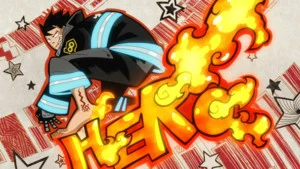
Shinra finally leans into a messianic role in this episode, and the show plays that choice both seriously and with a wink. Visually and thematically, he’s sheathed in the trappings of a larger-than-life hero — glowing, exaggerated, and almost cartoonishly confident. This tonal mixture results in an entertaining and sometimes hilarious depiction: the protagonist who’s part religious allegory, part shonen archetype.
That blend gives rise to the episode’s most divisive moment: is Shinra being presented as a Christ-like figure, or as a genre-savvy hero closer to Monkey D. Luffy? Fire Force knowingly blurs the line, inviting viewers to ask whether there’s any meaningful difference between mythic savior narratives and the caricatured heroism of classic shonen protagonists. It’s a bold creative choice, and when it succeeds, it’s genuinely fun; when it doesn’t, it undercuts gravitas.
Iris and the emotional counterpoint
Iris’s power-up arriving alongside Shinra’s is one of the episode’s quieter wins. The interplay between their developments provides an emotional anchor amid the spectacle: Shinra’s bombastic savior pose contrasts with Iris’s more spiritual, grounded presence, reminding viewers that the show’s heart beats strongest in its human relationships. The episode could have used more of those intimate beats to balance its larger set pieces.
Visuals, atmosphere, and adaptation choices that work
Even at its rushed pace, episode 16 boasts striking animation choices. The Adolla sequences are rendered with warped perspectives, saturated colors, and smoky, dreamlike textures that evoke the source material’s imaginative extremes. The corrupted dharma-wheel image and the ephemeral fire-hair on Raffles I are memorable motifs that stick long after the episode finishes.
Action choreography also benefits from the elevated stakes; the show commits to big set pieces and bold camera decisions. The montage of citizens bowing in fear and the collapsing cityscape sell the scale of the incursion better than dialogue alone could.
Where the episode falls short
Tempo remains the main shortcoming. Because events snap forward so quickly, the episode sacrifices character reaction time, meaningful exposition, and emotional transitions. Moments that should land as catharsis or dread instead play as fast-forwarded spectacle. A more patient episode might have used the Adolla imagery to deepen the series’ themes — about faith, control, and collective mythmaking — rather than briefly referencing them as staging for the fight.
Another problem is the sense of disconnection caused by gaps between cours. If viewers watched the season in an uninterrupted run, some of these pacing choices might feel less jarring. Spread apart by scheduling gaps, however, the rewrite-like compression of critical sequences can feel like narrative whiplash.
Where to watch and additional reading
Fire Force Season 3 is available for streaming on Crunchyroll. For further context on the series’ lore and production, the Fire Force entry on Wikipedia provides a concise overview and release history (Wikipedia — Fire Force).
Final thoughts
Episode 16 of Fire Force Season 3 delivers an unforgettable visual and thematic punch but does so at the expense of emotional density. The Raffles I reveal and Shinra’s ascension into a messianic hero archetype are bold, entertaining choices, yet the episode’s rapid adaptation pace muffles the deeper questions those moments raise. If you’re a fan of spectacle and high-concept worldbuilding, there’s a lot to love here; if you wanted a slower, more resonant climax to match the show’s ambition, this entry may feel like a missed opportunity. Either way, the series still manages to excite, and there’s reason to hope upcoming episodes will find room to let these themes breathe.