After twelve episodes, Dead Account wraps its season with a finale that aims for spectacle but largely settles for mediocrity. What could have been an explosive, cathartic payoff instead drifts into uneven pacing, half-baked resolutions, and tonal whiplash. There are moments that hint at potential—some effective visual beats and a few emotional flashes—but overall the episode struggles to justify the long build-up the season invested in its climactic confrontation.
Table of Contents
Pacing and Battle Execution: Too Long, Too Tepid
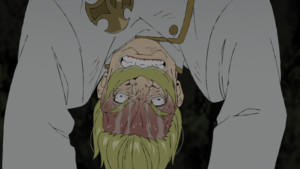
The finale’s central combat against Ban Ashina was expected to be the season’s high-octane crescendo, but it plays out as an overextended slog. Rather than delivering a tightly choreographed sequence that escalates tension and stakes, the fight stalls in repeated beats of marginal advances and retreats. Characters take turns landing glancing blows and strategizing for minutes at a time, which undercuts urgency and dilutes the payoff.
Part of the problem is a lack of inventive stakes or constraints within the battle itself. Opponents trade near-misses and blocked attacks without any evolving conditions that force creative adaptations from the heroes. When Hiyori finally seizes control of Ban’s gigantic ice statue—an admittedly striking visual—it feels less like earned strategy and more like a last-minute convenience to move the plot forward. That payoff would have landed far better had the show introduced earlier hints of environmental manipulation or given the statue a clearer narrative significance.
Tone and Aftermath: No Catharsis, No Mirror
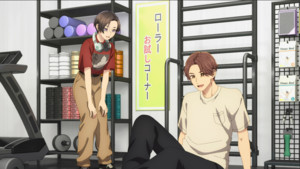
An effective finale often mirrors the opening of its arc, showing growth and transformation through parallel scenes or heightened aesthetics. Dead Account avoids that opportunity. Even after the supposed triumph, the episode fails to give viewers a gratifying denouement. The celebratory scenes are flat and awkward—events that should register as emotionally resonant come off as filler. The hot spring/hot tub sequence at the end is a tonal mismatch, feeling like a middle-of-the-cour gag rather than an earned epilogue for the arc’s conclusion.
This tonal dissonance robs the heroes’ struggle of meaning. After several episodes of attritional combat and personal stakes, audiences deserve a sequence that acknowledges the cost and growth involved. Instead, the finale opts for lightweight comedy and muted emotional signals, which makes the season’s ending feel like a shrug.
Character Development: Missed Opportunities
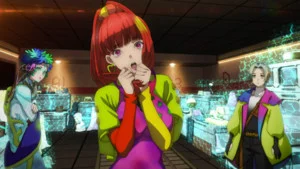
The team dynamics have been a central pillar of the series, but the finale doesn’t capitalize on them in a substantial way. Allies unite superficially but there’s little intimate payoff—no reflective beats showing how characters changed from the arc’s beginning. Soji, Dai, Hiyori and the rest execute the essential moves to secure victory, yet the episode never digs into how the experience reshaped their outlooks or relationships.
Even minor characters with potential for meaningful closure are reduced to background participation in party scenes, which feels like an excuse to wrap up loose ends without addressing them properly. A stronger script would have used the final confrontations to deepen the protagonists’ arcs, not just to clear the board of threats.
Villain Analysis: Sad Boy K’s Weak Menace
Sad Boy K, the show’s central antagonist, remains disappointingly underwhelming in the finale. The season positions him as an ominous, conceptual threat—someone capable of building a “ghost nation” of accounts and destabilizing the world—but his on-screen behavior rarely matches that billing. The few times he engages in direct conflict, he oscillates between mildly competent and cartoonishly inept, disappearing at the first hint of difficulty.
The closing scene teases a larger scheme: Sad Boy K observing from the shadows and hinting at broader ambitions. But the moment reads more like a Saturday morning villain’s cackle than the emergence of an existential threat. For a finale to land, the antagonist needs presence, credibility, and a clear, well-supported motive. Here, the payoff is mostly rhetorical—promises of future plans—without sufficient demonstration of the threat’s depth.
Animation, Direction, and Sound: Glimpses of Quality
Despite its narrative shortcomings, the episode showcases a few technical strengths. Certain shots—particularly Hiyori’s sequence with the ice statue—are framed effectively and deliver memorable silhouettes. Background art and effects work provide some spectacle, even if choreography and camera logic occasionally undermine clarity.
The sound design and score provide appropriate moments of tension and release, but the show rarely leverages them to elevate the emotional stakes. A stronger directorial approach—sharper editing, more defined beat structure, and more daring sound cues—could have turned several flat stretches into compelling sequences.
Cliffhanger and Future Potential
The finale ends on a cliffhanger that hints at a larger game being played behind the scenes. That tease is the episode’s most salvageable element: it suggests the series could address its shaky villain construction and tonal balance in a subsequent season. However, for such a setup to be satisfying, future episodes will need to commit to building Sad Boy K into a believable threat and to tightening the show’s narrative rhythm.
If the series returns, it would benefit from clearer escalation rules, better integration of character beats into action sequences, and a willingness to double down on either grim stakes or lighthearted comedy—tonal compromises have been the show’s undoing this season.
Where to Watch
Dead Account is available for streaming; one official source is Crunchyroll. For community discussion and episode indexing, see the series entry on MyAnimeList.
Final thoughts
Episode 12 of Dead Account is emblematic of the series’ strengths and weaknesses: flashes of visual ambition and a central premise that intrigues, undermined by inconsistent pacing, tonal mismatches, and an undercooked antagonist. The finale doesn’t explode in a blaze of satisfying conclusions; instead, it winds down with missed opportunities and a cliffhanger that asks us to trust in a future payoff. There’s potential here, but the show needs tighter writing and clearer stakes to transform promising ideas into truly memorable moments.