Thunder 3’s sixth episode continues the pattern that has frustrated many viewers: a narrative that leans heavily on spectacle while sidelining its ostensible protagonists. This installment rarely lets The Small Three take center stage, instead lingering on stock 3D-CG characters whose expressions and body language do little to sell the stakes. Below I break down what works, what doesn’t, and why this episode feels like a missed opportunity for a series built on a strong manga premise.
Table of Contents
Episode 6 — Brief recap
The episode opens with a tense, unsettling scene featuring a lost child, Futaba, wandering near the alien mothership. Interspersed with this are sequences focused on Segami and his heavily armed paramilitary group disembarking into the city and engaging a towering alien death machine. There are brief glimpses of inventive worldbuilding—QR-code training aids, a nasal spray derived from alien fluids—but the core action sequences are hampered by glacial pacing and emotionally inert performances from most characters.
Character animation: When CG flatlines
Thunder 3’s biggest obstacle remains its character animation. For a 3D-CG production, the show paradoxically communicates the least through faces and movement. Background characters and minor players act as inert set dressing, rarely conveying genuine surprise, fear, or urgency—even when an enormous alien machine is stomping through the street. This lack of believable reaction undermines dramatic beats: a city under invasion should feel chaotic, but the bystanders behave as if they were extras in a safety drill.
Segami and the Small Three: sidelined protagonists
Segami, nominally one of the main characters, comes off as particularly flat. His actions drive some of the episode’s confrontations, but his emotional arcs are muted to the point of being unreadable. The Small Three—promised as central perspectives in the story—barely appear, which weakens viewer engagement. When a supporting character dies mid-fight, the show expects the audience to feel impact, but only numbness registers: the scene lacks any demonstrable grief or shock that would make the loss meaningful.
Pacing and dramatic structure: padded and slow
One of the recurring criticisms throughout the season is padding. Moments that read concise and impactful on the page are stretched into long sequences here, diluting tension rather than building it. The episode’s Futaba scenes, which should be a quick, eerie counterpoint to the urban chaos, are protracted to the point of testing patience. Conversely, some potentially interesting plot beats—like the origins and effects of the alien-derived nasal spray—are hinted at and then shelved, creating a lopsided rhythm of reveal-and-abandon.
Why the fights feel boring
There are several contributing factors to why battles fall flat: the glacial pacing removes the urgency; character performances lack expressive variation; and the direction seldom composes shots that make the spatial stakes clear. Aerial or large-scale fights in animation often succeed by varying camera movement and letting characters react in vivid, human ways. Thunder 3’s tendencies toward static framing and emotionless faces make even explosive set pieces feel bland.
Small victories: Futaba, Q-chan, and worldbuilding curiosities
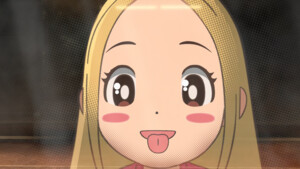
Not everything in episode 6 is negative. The opening sequence with Futaba—lost, frightened, and strangely compelling—offers one of the episode’s few emotionally resonant moments. Her naive interaction with the small furry creature Q-chan provides a welcome tonal counterbalance: it’s cute, eerie, and hints at deeper mysteries about the nature of the invaders and human responses to them. Unfortunately, these scenes are stretched longer than they need to be, but they nonetheless highlight the show’s potential when it leans into smaller, character-driven moments.
Worldbuilding details are another bright spot. The idea that paramilitary units get basic training via QR-code links on their phones is clever and satirical in equal measure; it reads as a contemporary commentary on the outsourcing of expertise to quick digital guides. The nasal spray made from alien bodily fluids is another intriguing, creepy touch—it feels like something that could tie into larger ethical or scientific threads later in the series, if given the space to evolve.
Where the adaptation goes wrong
This episode exposes several adaptation weaknesses that may stem from trying to stretch manga material to a fixed runtime without the nuance to fill it dramatically. The show pads scenes rather than enriching them, which sacrifices crisp storytelling for runtime. The heavy reliance on 3D CG also magnifies expressive shortcomings: if facial rigging and body animation cannot convey micro-expressions, the result is a visual deadening of characters who should feel alive and reactive.
Suggested fixes if production revisits the approach
- Prioritize facial animation and micro-gestures in close-ups to restore emotional clarity.
- Trim unnecessary padding; let the script breathe by focusing on fewer, sharper scenes that reveal character.
- Use shot variety and camera motion to communicate scale and urgency in battle sequences.
- Allow secondary worldbuilding elements—like the QR code training and nasal spray—to be followed up sooner so they pay narrative dividends.
Streaming and viewing notes
For viewers who want to watch for themselves, Thunder 3 is available on major streaming platforms. If you’re interested in how 3D-CG is applied across modern anime and the technical challenges involved, a basic primer on 3D computer graphics can be found here (external resource): 3D computer graphics — Wikipedia. For streaming access, check current region availability (example link): Thunder 3 on Netflix.
Final thoughts
Episode 6 of Thunder 3 has sparks of good ideas—memorable worldbuilding beats and a genuinely eerie Futaba sequence—but it’s undermined by bland 3D character animation, padded scenes, and a tendency to sideline the central cast. The show occasionally flirts with the kind of emotional clarity and narrative momentum that would make it compelling, but too often those moments are diluted by production decisions that favor runtime over resonance. If the series tightens its pacing, invests in more expressive character animation, and follows through on its curious worldbuilding, it could still find its stride. For now, however, this episode is a frustrating mix of potential and under-delivery.