Episode 10 of A Hundred Scenes of AWAJIMA digs deeper into the show’s central obsessions: legacy, identity, and the price of celebrity. Rather than advancing a single linear plot, this installment interweaves three related vignettes that examine how children of famous performers reckon with the public lives their parents led—and how those legacies shape, buoy, and sometimes drown them. With careful direction, pointed writing, and a memorable piece of surreal imagery, the episode reinforces the series’ quiet power while asking difficult questions about authenticity and belonging.
Table of Contents
Concise recap: three connected vignettes
The episode splits into three parts. First, an extended interview with Shinji (now an adult writer) and his reflections about growing up with Utako, a celebrated Awajima alum. The middle segment centers on Yukari, the privileged but determined daughter of Fumiko Shiro, who faces rejection from Awajima and must confront the limits of inherited advantage. Finally, Ibuki revisits a painful memory involving Emi and her own grandmother, tying the episode’s themes together and closing with a stark, haunting image that lingers.
Shinji and Utako: memory as a public performance
Shinji’s interview stands out for how it frames personal history as a kind of public storytelling. The show has repeatedly used interviews as a device to give characters an economical way to voice interiority, and here that mechanism carries thematic weight. Shinji admits that, as a child of a famous actress, he learned early how to compress and present family life so it could be understood by others. That editorial impulse is not malicious—it’s adaptive. Still, it leaves an emotional distance between him and his mother.
The segment avoids melodrama and instead settles into a bittersweet register: Shinji respects Utako’s career and accepts the sacrifices it required, but he also recognizes the estrangement it created. Returning to live with his mother as an adult complicates that relationship—he now sees the frailty and loneliness under the persona. The scene quietly asks whether any public image can ever capture the whole person, and whether the child of a celebrity can ever truly know the parent behind the role.
Yukari and privilege: the nepo-baby arc
Yukari’s story functions as a foil to Shinji’s. Introduced as “Fumiko Shiro’s daughter,” she initially treats acceptance to Awajima as a foregone conclusion—an entitlement shaped by her mother’s name and the academy her mother runs. Her rejection forces a reckoning: she could lean on nepotism and have her mother write on her behalf, but that would undermine whatever agency she hopes to claim. The choice to decline easy influence and commit to more work is, narratively, a tidy beat. Yet the segment earns its emotional freight by acknowledging the mixed motives involved—Yukari still wants to be her mother’s daughter, even while rejecting the shortcut.
That tension between inherited advantage and genuine aspiration is one of the episode’s core questions. It echoes real-world debates about privilege in creative industries; for a general overview of the dynamics at play in such scenarios, see this Britannica entry on nepotism (rel=”nofollow” target=”_blank”>https://www.britannica.com/topic/nepotism)
Visuals and direction: surrealism as emotional truth
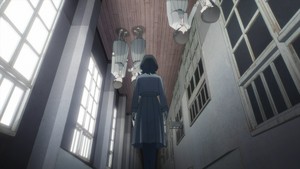
Where the episode truly sings is in its visual translation of shame, isolation, and memory. Ibuki’s recollection of Emi’s social exile is rendered with unsettling surrealism: rain puddles forming on the ceiling, classmates walking past on indifferent surfaces, and Emi literally sinking beneath a tide that drags her away from the bright halls of Awajima. This kind of internal-state animation has been a consistent strength of the series—transforming psychological pain into imagery that feels both dreamlike and viscerally real.
Equally effective is the way the episode frames present-day interludes. Wakana at Ibuki’s bedside reframes the earlier vignettes, shifting the mood from wistful to elegiac. The hospital becomes less a place of reprieve and more a mausoleum-like reminder that certain experiences—especially those formed within Awajima’s culture—carry a weight that shapes a person long after the performance lights dim.
Thematic analysis: legacy, masks, and the impossibility of total knowledge
Interviews as a mirror
The recurring interview device in the series functions on two levels. Practically, it allows the show to handle a sprawling cast without sprawling runtime. Thematically, interviews underline the show’s fixation on image—how performers and their families must constantly curate how they appear to the world. But the series also problematizes the notion that interviews can reveal the “real” person. Characters narrate versions of themselves that are inevitably shaped by memory, shame, and pride. The result is an episode that asks whether anyone can fully articulate who they are, or whether we always rely on narratives that make sense to others more than to ourselves.
Being “someone’s child” as identity and burden
Both Shinji and Yukari illustrate how parental fame becomes an identity shorthand that others use to interpret and limit a child. For Shinji, Utako’s reputation sketched the outlines of his own story and left him guessing at the woman beneath the roles she played. For Yukari, the label opened doors but also created expectations she hadn’t earned. The episode suggests that being “someone’s child” is simultaneously empowering and suffocating—an inheritance that carries both benefits and unresolved questions.
Why Episode 10 matters in the larger series
This episode refines the show’s central motifs rather than redirecting them. It places interpersonal nuance over plot mechanics, trusting that small, intimate revelations will accumulate into something resonant. The intercutting between past interviews and present bedside scenes reinforces the idea that Awajima itself is less a school than a force that shapes lives in ways both visible and subterranean. For viewers invested in character study and thematic depth, Episode 10 is a reminder of why the series has sustained its contemplative tone.
Where to watch
A Hundred Scenes of AWAJIMA is streaming on Crunchyroll (rel=”nofollow” target=”_blank”>https://www.crunchyroll.com/series/GT00374363/a-hundred-scenes-of-awajima). If you’re following the series for its character-driven moments and visual metaphors, this episode is a clear example of how the show turns small moments into lasting impressions.
Final thoughts
Episode 10 of A Hundred Scenes of AWAJIMA is less about plot advancement and more about excavation—uncovering the emotional sediment left by fame, family, and performance. Through restrained dialogue, careful composition, and one indelible piece of surreal imagery, the episode deepens our understanding of how the Awajima legacy persists in its alumni and their children. It asks hard questions about authenticity, the stories we tell about ourselves, and whether distance can ever fully heal the dissonance between the person on stage and the person at home. For viewers drawn to quiet, reflective anime that examines identity through interpersonal detail, this is an episode that rewards close attention.