MAO’s mid-season stretch delivers a curious blend of comic oddities and sudden, teeth-baring drama. Episodes 5 and 6 prove to be an interesting tonal pairing: one plays to Rumiko Takahashi’s knack for charming weirdness and character-driven silliness, while the other accelerates the plot into darker, mystery-heavy territory. Together they reinforce that this adaptation is willing to shift gears—sometimes abruptly—to keep viewers engaged.
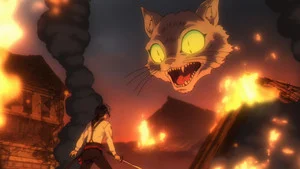
Table of Contents
Episode 5: Flea Nuns, Research, and Light-Hearted Worldbuilding
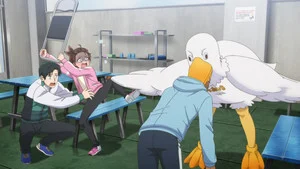
Episode 5 leans into the series’ comedic DNA. The standout gag—flea nun monsters—might sound absurd on paper, but the episode uses that absurdity to show character and world details rather than just punchlines. Nanoka’s decision to take her time and actually research the era she’s been visiting is an especially welcome touch. It makes her more proactive and curious instead of a passive “fish out of time,” and the small moments of her learning about the past provide genuine warmth.
A softer tempo that still serves character
Where many adaptations might rush through such beats, this episode allows itself to breathe. The result is a charming mix of slapstick and subtle development: the monster-of-the-week conceit is funny, but it also deepens our sense of the supernatural rules and how Nanoka’s modern sensibilities clash (and sometimes blend) with the past she keeps stepping into.
Episode 6: Byoki’s Reveal and Sudden, Sweeping Stakes
By contrast, episode 6 pivots hard from light comedy to one of the show’s most consequential reveals so far. We meet Byoki, whose raspy, gravelly presence immediately changes the show’s energy. The episode unspools important backstory about what happened the day Nanoka lost her parents and suggests that there are layers to MAO’s and Byoki’s history that neither character has fully understood yet. For a story still early in its run, this episode’s forward momentum is pleasantly surprising.
Fast-paced openings, long-term payoffs
Fans of Rumiko Takahashi’s work will recognize a familiar structural rhythm: quick, kinetic openings that drop you into action, then more leisurely storytelling that lets the emotional and comedic notes linger. Episode 6 flips the expected leisurely pace and instead charges toward a big reveal earlier than some might have anticipated. That acceleration makes the series feel urgent and alive, as if there’s more at stake—and sooner—than it initially let on.
Millennia of obsession and a new emotional center
Byoki’s monologue and history paint him as more than a one-note antagonist: he’s a tragic, almost obsessive figure who’s been shaped over centuries. The hint that Nanoka might be more connected to his past than anyone realized ramps up the personal stakes. Toss in a backdrop of disaster—the Great Kanto Earthquake—plus the sudden presence of a child Nanoka during the chaos, and you have a sequence that combines spectacle with emotional weight. The episode nails that delicate balance, making the dramatic turn feel earned rather than abrupt.
Pacing, Direction, and Narrative Momentum
One of the season’s strengths is the willingness to alternate tempo—comic detours followed by heavy plot beats—without either style undermining the other. Episode 5’s leisurely humor isn’t filler; it’s character work that makes episode 6’s revelations hit harder. Meanwhile, the show’s unpredictability about how time flows between worlds (it’s inconsistent, inconvenient, and sometimes dangerous) keeps the supernatural mechanics intriguing rather than expository. That ambiguity works in the show’s favor: time travel feels like an active mystery rather than a neat toolbox.
Visual storytelling and atmosphere
When the series leans into high drama, the animation and layout respond. The transformation sequences, Byoki’s full-powered moments, and the city-in-flames imagery during the earthquake scene deliver a strong visual punch. These moments are contrasted with quieter, humorous setups where character expressions and timing do the heavy lifting, showing that the production can handle a broad tonal palette.
Voice Acting and Character Work
Byoki’s voice—deep, scratchy, and unsettling—lands immediately. Takashi Matsuyama (as reported in promotional materials and casting notes) brings a gravitas that sells the character’s age and obsession; his presence alone reshapes the scenes he’s in. Nanoka’s curiosity and vulnerability remain central, and the cast overall balances comedy and drama effectively.
Familiar echoes and fresh takes
It’s impossible not to notice certain echoes of Takahashi’s earlier works—dramatic stand-offs, drawn-out brooding, bursts of chaos—yet MAO reinvests those familiar beats with new texture. The series reframes those tropes in a slightly faster, more urgent tempo, which helps the story feel both nostalgic and surprise-driven at once.
Where to Watch
MAO is available for streaming on Hulu. For more background on Rumiko Takahashi’s long career and recurring storytelling patterns, see her profile on Wikipedia.
Final thoughts
Episodes 5 and 6 together showcase MAO’s strengths: an ability to flip between whimsical oddities and large-scale emotional stakes, strong voice performances, and a willingness to accelerate the plot without sacrificing character moments. If episode 5 is the show smiling and teasing, episode 6 is the show baring its teeth—and both are essential. This stretch makes MAO feel like one of the season’s most compelling titles, one that rewards both patience for the small details and attention to sudden revelations. I’m eager to see how the mysteries teased here resolve and what new layers Takahashi’s world will reveal next.