Episode 7 of In the Clear Moonlit Dusk, titled “You on the Night of the Festival,” shifts the series’ usual tone by leaning into atmosphere, symbolism, and a single emotionally fraught encounter. After several episodes of restrained animation and flat staging, this instalment uses festival lighting, shrine architecture, and traditional motifs to elevate a simple confrontation into something quietly resonant. Below I break down what worked visually, how the episode handles character communication, and why the festival setting matters to Yoi and Ichimura’s relationship.
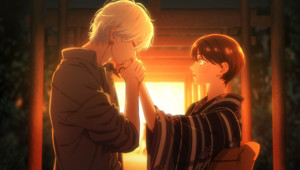
Table of Contents
Episode overview: A festival, a mask, and a turning point
Much of the episode unfolds at a local summer festival, placing characters in a charged public space where private feelings collide with tradition and anonymity. Ichimura spends most of the episode brooding in jealousy, convinced his relationship with Yoi is already over after a string of hollow romances. Yoi, meanwhile, approaches the night with guarded vulnerability — she dresses in a yukata, dons a fox mask, and steps into a liminal shrine space that frames the emotional stakes. The episode ends with a blocked kiss and the pair walking back through the festival together, an outward gesture of companionship that hints at internal change.
Visuals and animation: Lighting as emotional language
Where earlier episodes sometimes felt visually flat, this chapter benefits from its festival backdrop. Booths and lanterns produce warm pools of light that transform ordinary streets into intimate islands. The animators use contrast and framing (especially under vermilion torii gates) to suggest otherworldliness — the shrine stairs, masked figures, and fog create a stage-like environment where the scene feels less like everyday life and more like ritual.
Character animation remains restrained, but the directors compensate with careful staging, lighting, and color. The festival’s warm hues soften the characters’ outlines and offer emotional cues: Ichimura’s moments of sincerity are bathed in a warmer palette, while the mask and late-night shadows emphasize Yoi’s protective distance. This episode demonstrates how strong art direction can mitigate limited motion and still deliver meaningful visual storytelling.
Themes and symbolism
This episode is dense with cultural and symbolic references that reinforce its central theme: the tension between outward appearance and inner truth.
Kitsune, masks, and transformation
Yoi appears wearing a fox mask in front of torii gates, evoking kitsune — foxes in Japanese folklore associated with trickery, transformation, and the deity Inari. Masks in storytelling function to both conceal and protect; here, Yoi’s mask shields her vulnerability. The fox motif suggests ambivalence: kitsune are playful and mischievous but can also be guardians. Yoi’s masked presence positions her as both enigmatic and self-protective, a young woman who adopts a persona to avoid emotional harm.
Torii gates and liminality
The vermilion torii gates where Yoi confronts Ichimura create a clear liminal space, a threshold between the ordinary world and the sacred. By staging their encounter amid shrine architecture, the episode signals that this moment is a ritualized turning point, not just a casual date-night spat. The torii emphasize transition — from denial to acknowledgment, from guardedness to tentative openness.
Morning glories, yukata, and seasonality
Yoi’s yukata pattern of morning glories (a hanakotoba symbol for “summer love”) reinforces the seasonal and emotional language of the episode. Yukata and fireworks are staples of summer romance in Japanese media, and the use of these motifs situates Yoi and Ichimura’s interaction within that tradition: fleeting, beautiful, and charged with possibility. That Yoi didn’t previously own a yukata but appears in one suggests intentionality — she’s performing readiness to engage the past, the present, or a potential future.
Character dynamics: Silence, texts, and modern miscommunication
A large portion of the episode examines how modern communication can mask emotional distance. Ichimura and Yoi both avoid texting, but for opposite reasons: Ichimura is in denial and refuses to engage, believing it’s pointless; Yoi prefers silence over the risk of explicit rejection. This dynamic is painfully realistic — in an age when communication tools are ubiquitous, silence often becomes the loudest signal. The episode captures the way avoidance can produce escalating misunderstandings, and how one small act of courage (or reluctance to act) shapes interpersonal outcomes.
Additionally, Ichimura’s nostalgia for shallow past relationships contrasts with his slowly dawning sincerity toward Yoi. His internal monologue about previous girlfriends treating him as a status symbol emphasizes his fear of being loved superficially; Yoi’s guardedness stems from a different fear — inexperience and the anxiety of being hurt. Their mutual hesitation makes the festival encounter feel like a fragile bridge rather than a resolved arc.
Festival setting: Cultural resonance and narrative function
Festivals in Japanese storytelling are frequently used to amplify emotions. They bundle ritual, nostalgia, and communal celebration into a heightened temporal space where characters can step outside daily identities. While the episode doesn’t delve into the religious specifics, the shrine, torii, and kitsune folklore provide cultural texture that deepens subtext. For readers wanting to learn more about Inari and torii symbolism, Britannica has a concise primer on Inari that contextualizes the mythology and shrine practices (external link, rel=”nofollow”): Britannica — Inari.
Where to watch
If you want to revisit the episode to catch the subtle visual cues and costume details, In the Clear Moonlit Dusk is streaming on Crunchyroll (external link, rel=”nofollow”): Crunchyroll — In the Clear Moonlit Dusk.
Final thoughts
Episode 7 is one of the series’ more successful experiments with atmosphere and symbolism. Even with modest animation, careful art direction, lighting, and cultural motifs create an emotionally rich hour that foregrounds the protagonists’ miscommunication and guardedness. The festival provides a perfect theatrical backdrop for a turning point: Yoi’s mask, the torii liminality, and the morning-glory motifs all work in concert to express what the script leaves unsaid. For viewers invested in the characters’ slow-burn dynamic, this episode rewards close attention to the visual details and the small, meaningful gestures that hint at change.