Episode 7 of You and I Are Polar Opposites leans into the series’ strongest suit: awkward, character-driven comedy that quietly deepens relationships. This installment balances brief but revealing character moments—especially for Taira and Nishi—with the kind of subtle romantic setup that makes a slice-of-life romcom addictive. Through short, punchy scenes and smart comedic timing, the episode expands the cast’s dynamics while keeping the laughs coming.
Table of Contents
Rihito/Taira: The resident sad boy gets a rare spotlight
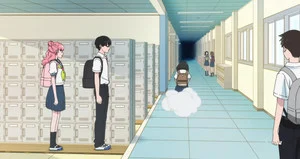
One of the episode’s quieter pleasures is the unexpected return of Rihito (Taira). He’s only around for a short stretch, but his presence adds emotional texture. The episode uses middle-school nostalgia as a foil to Taira’s chronic pessimism—where others find fond memories, he sees reminders of loneliness and failed expectations. That bitterness is played for laughs, but the script also drops hints of something more: an allusion to a past relationship that fell apart because his personality didn’t match someone else’s expectations.
This small hint works well. Taira’s worldview is already clear from earlier episodes—he’s got the grumpy, misanthropic persona down—but teasing a backstory gives him depth without slowing down the show’s tempo. It’s the kind of economical character beat that keeps viewers curious about future development while maintaining the episode’s light touch.
Nishi’s neurotic charm: from awkward texts to crushing realization
This episode belongs to Nishi in terms of emotional payoff. Previously pigeonholed as the girl who freezes mid-conversation, Nishi finally admits she overthinks replies and tries to clear things up with Yamada. His reaction is a highlight: patient, good-natured, and perfectly attuned to handling her anxieties without drama. That kindness becomes the catalyst for Nishi’s internal crisis—she discovers her heart races around him and that a simple smile can make her flee.
The show handles that discovery with great comedic timing. Instead of melodrama, we get a string of neurotic responses and a cast of friends who mirror real-world reactions: Honda’s blunt skepticism, practical advice, and brutal honesty. Honda’s suggestion—don’t worry about hypothetical scenarios; find out why this is happening—serves as both a comedic beat and genuine guidance, nudging Nishi toward self-awareness without heavy-handedness.
Conversation practice as character development
Yamada offering to help Nishi practice conversation is a small scene, but it functions as character development in disguise. Their personalities—blunt versus overthinking—actually complement each other, setting the stage for natural chemistry without forcing romantic tropes. Those gentle, awkward coaching moments are exactly the kind of romcom content fans love: intimate, awkward, and honest.
Tani and Miyu: misreads, maturity, and an unexpected strategist
Tani’s reaction to Miyu’s glare is another strong thread. His instinct is to reassure her and avoid making her uncomfortable, which shows a maturity that’s refreshing in this genre. Tani wants Miyu to be able to lean on him as she does him, so he misinterprets the scene out of concern for her feelings—an understandable and human response.
The twist here is Miyu herself. Rather than being jealous, she’s been carefully observing the dynamics between Yamada and Nishi and is actively trying to shepherd Nishi into the friend group. Miyu’s “calculations” and strategic nudging are a hilarious reversal: she’s socially savvy and almost unnervingly perceptive, capable of plotting romantic logistics in a way that undercuts a lot of romcom stereotypes. Her quiet competence makes her an invaluable ally—and an unexpectedly funny one.
Why this episode works: tone, pacing, and character-driven humor
Episode 7 succeeds because it trusts its characters. The comedy arises naturally from personality clashes rather than contrived setups. A few elements stand out:
- Efficient use of screen time: Secondary characters like Taira are given meaningful beats without derailing the main narrative.
- Character contrast: Yamada’s easygoing nature plays perfectly against Nishi’s anxiety and Taira’s cynicism.
- Subtle emotional stakes: The episode layers humor over genuine developmental steps—Nishi’s realization, Tani’s maturity, Miyu’s mentoring—so laughs and heart coexist smoothly.
Standout moments
– Taira’s nostalgic bitterness, which is both funny and slightly heartbreaking.
– Nishi’s awkward confession and her subsequent panic when face-to-face with a real crush scenario.
– Miyu’s deadpan calculation to help Yamada and Nishi get closer—an unexpectedly strategic move that flips the jealousy trope.
Where the show might be heading
This episode sets up several potential arcs: deeper exploration of Taira’s past, Nishi slowly learning to handle her anxiety around Yamada with Miyu’s help, and Tani growing more confident in articulating his feelings and boundaries. The series seems committed to letting these relationships grow at a believable pace, favoring gradual development over rushed declarations—an approach that often yields stronger emotional payoffs later on.
If the show continues to mine comedy from honest character interactions while sprinkling in small emotional reveals, future episodes should deliver both laughs and satisfying progress in each pairing. The presence of perceptive side characters like Miyu ensures there will be clever, unexpected beats rather than predictable misunderstandings.
You and I Are Polar Opposites is currently streaming on
Crunchyroll.
Final thoughts
Episode 7 is a tidy, character-first entry that deepens relationships while keeping the comedy sharp. It gives Nishi meaningful growth, teases complexity for Taira, and showcases Miyu’s sly competence—proof that the series can balance awkward humor with genuine character beats. For viewers invested in slow-burn romantic development and character-driven laughs, this episode is a strong reminder of why You and I Are Polar Opposites remains easy to root for.
For more background on the series, you can also check the Wikipedia entry for general production details (external link).