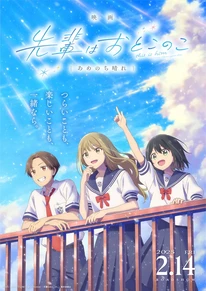
The feature-length epilogue to the Senpai is an Otokonoko TV series, Sunshine After the Rain, is a tender, introspective film that chooses quiet character work over flashy spectacle. Focusing tightly on Saki’s emotional crossroads while allowing Makoto and Ryuji to play meaningful but supportive roles, the film explores identity, family dynamics, and the slow, honest work of learning to love yourself — and someone else. Below I break down the film’s core strengths, themes, and how it fits as a satisfying cap to the television run.
Table of Contents
Synopsis: a season of change and inward reckonings
Sunshine After the Rain picks up as the school year shifts and its characters face the transitionary pressure of growing up. Saki must contend with her mother’s return, a visit to her father in Hawaii, and the realization that her grandmother is aging. Makoto, now a third-year, wrestles with new responsibilities and feelings toward Saki. The film asks whether daylight can return once these clouds settle — and answers with a quiet, emotionally honest “maybe.”
Character focus: Saki’s journey to choosing herself
Although Makoto and Ryuji appear throughout, this film foremost belongs to Saki. Earlier episodes portrayed her as upbeat and a touch performative; Sunshine After the Rain strips that away to reveal the fatigue beneath the smile. The film stages several intimate moments — family conversations, private breakdowns, and symbolic choices — that chart Saki’s movement from people‑pleasing toward a self that recognizes its own wants.
Visually, the film communicates Saki’s interior life subtly. Scenes with her mother often obscure Saki’s eyes, leaving only her mouth in light; it’s a smart directorial shorthand for concealment. By contrast, encounters with her father and grandmother allow more warmth and vulnerability, making her eventual decision to “turn herself” toward her own life all the more earned.
Family as both friction and mirror
Saki’s mother represents the past she’s expected to inhabit — a version of her as a child who can be reshaped with little consent. Her father, meanwhile, offers a gentler, more observant presence. His realization that Saki is no longer the child who shared his interests is believable and compassionate; he asks her to join him only after understanding who she is now. These family dynamics are the film’s engine: each interaction forces Saki to confront what she will accept and what she will leave behind.
Makoto and Ryuji: growth in the margins
Makoto’s arc in the film is quieter but meaningful. His greater emotional confidence — from standing up to antagonists like Fujii to being steadier around Saki — highlights how much he’s grown since the series began. Ryuji’s role is supportive and highlights the film’s theme of shared care: not everyone needs the spotlight to be essential to the story. That said, viewers who loved Ryuji might wish for a bit more screen time; the film consciously prioritizes Saki’s resolution.
Thematic threads: identity, acceptance, and quiet bravery
What makes Sunshine After the Rain resonate is its refusal to sensationalize identity struggles. Instead, the narrative insists on small, human truths: you can be complicated; you can be performing for others and still be real; loving someone else requires first tolerating your own uncertainty. The film’s best sequences — including a striking, low-key confession scene — are powerful because they’re intimate, not theatrical.
Symbolism and motifs
Motifs like the sea and the whale in Saki’s Hawaii visit underline the film’s meditation on scale and surrender. Encounters with vastness grant perspective and a sense of calm, mirroring internal acceptance. Small gestures — turning a photograph over, a soft breakdown with a grandmother — become narrative punctuation marks that show progress rather than instant fixes.
Presentation, pacing, and the release format
Visually and narratively, the film favors restraint: clean animation, focused framing, and an editing rhythm that values breathing room. One notable distribution choice was splitting the movie into four episodes of varying lengths on some streaming platforms. That format can be practical for modern viewing habits but slightly undercuts the unified momentum of a film experience. Even so, the emotional beats remain intact, and the payoff feels satisfying.
For viewers who want to rewatch or stream, official platforms that carry the film can provide a convenient way to revisit key scenes and character moments. For instance, many viewers first encountered this epilogue through widely available streaming services such as Crunchyroll (external, nofollow). If you prefer catalog information and credits, databases like IMDb can be useful references (external, nofollow).
Why Sunshine After the Rain works as an epilogue
Not every series needs a cinematic conclusion, but when a film like this arrives it should deepen the characters rather than simply extend the plot. Sunshine After the Rain succeeds by centering emotional honesty over dramatic twists. It gives Saki the space to reckon with family, identity, and the tentative steps of romantic openness, and it allows Makoto and Ryuji to land their growth in service of her story. The result is an elegant, quietly hopeful epilogue.
Final thoughts
Sunshine After the Rain is a gentle, resonant capstone that rewards patience and attention. Its greatest strength is listening to its characters long enough to let them surprise themselves — and us. If you loved the TV series for its warmth and character work, the film is a satisfying continuation: subdued, emotionally literate, and ultimately upbeat about the possibility that, after turmoil, sunlight returns.