Season two of My Hero Academia: Vigilantes barrels toward its climax in episode 25, attempting to cram a wealth of emotional beats, reveals, and action into a single hour. The result is a mixed bag: moments of genuine pathos and thematic payoff sit beside rushed character revelations and a frenetic finale that feels more like a springboard to the next arc than a satisfying seasonal cap. Still, this episode delivers several standout sequences—especially those that lean into All Might’s presence and the complicated legacy of heroism—making it worth unpacking.
Table of Contents
Episode pacing and narrative structure
The biggest issue this episode faces is pacing. There’s an admirable desire to resolve multiple threads—Knuckleduster’s confrontation with Number Six, the reveal of Six’s origin, and the intervention of All Might—but packaging all of that into one episode leaves several scenes feeling undercooked. Where season one slowly built relationships and allowed twists to land with weight, this finale rushes through pivotal moments that deserved fuller breathing room. The show frequently flirts with strong dramatic ideas, yet here those ideas often feel like sketches rather than finished paintings.
Character moments that land
All Might and Naomasa: the emotional anchor
One of the episode’s strengths is its quieter emotional center: Naomasa calling All Might for help. This scene accomplishes two things at once. First, it humanizes Naomasa—he’s shown to be a restrained, sincere friend who won’t weaponize his relationship with All Might. Second, it reaffirms what All Might represents in this world: a figure who can be relied upon not just as a powerhouse but as an emotional lodestar. The show even acknowledges the risk of a deus ex machina by naming All Might’s arrival as such, but the moment still carries genuine pathos. The line about asking for help making impossible feats possible is simple but effective, showing All Might’s complexity as someone who embraces mutual reliance rather than lone-wolf heroics.
Knuckleduster, Koichi, and the meaning of legacy
Knuckleduster remains one of Vigilantes’ most compelling figures, and his dynamic with Koichi continues to be the emotional core of the series. This episode’s decision to position Koichi as a superior successor—someone who reveres All Might and what he stands for—gives Knuckleduster a moment of clarity: he sees in Koichi the potential to become the kind of hero he no longer believes himself to be. That recognition is a quieter, more mature payoff than a triumphant victory; it’s about legacy and the passing of ideals, and it adds depth to their relationship even if the build-up to the confrontation feels rushed.
Number Six: backstory and missed opportunities
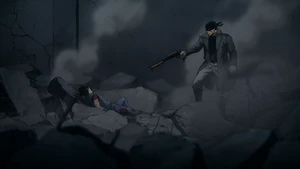
Number Six’s reveal—that he is the product of laboratory experimentation and was groomed by footage of O’Clock—hits familiar beats but loses some of the emotional punch it could have had. The prior expectation, that he might be a betrayed former sidekick of Knuckleduster, would have delivered a heavier personal sting. Instead, the lab origin reframes Six as a tragic experiment who models himself after a perceived successor rather than a true comrade. It’s an effective characterization in its own right, but the episode doesn’t fully capitalize on the moral ambiguity and moral horror of such an upbringing. The scarred mimicry of Knuckleduster’s wounds and his obsession with succession are interesting, but they deserve more time for viewers to truly feel the tragedy.
Thematic throughlines: power and choice
Where this episode succeeds thematically is in its meditation on absolute power and moral choices. Number Six’s speech—claiming that those with absolute power have only two paths: absolute good or absolute evil—echoes the larger My Hero Academia mythos (All Might vs. All For One) but reframes it through a Vigilantes lens. That line becomes a lodestar for the episode: All Might embodies the “absolute good” while figures like All For One represent the opposite. This dichotomy enriches Six’s motivations and gives the finale a philosophical backbone, even when the plot mechanics feel hurried.
Action, choreography, and staging
The episode’s action sequences are a mixed affair. Knuckleduster’s preplanning—planting explosives and setting traps—adds tactical depth and grounding to the fight, and there are visually satisfying moments where street-level guile meets raw power. However, the choreography sometimes becomes convoluted, with too many plot beats and quick cuts that undermine the emotional stakes. It’s a shame, because individual moments (a well-placed explosive, a desperate hand-off, All Might’s entrance) are compelling in isolation. The episode reads better when it focuses on motive and consequence than when it tries to juggle spectacle and exposition simultaneously.
What works, what doesn’t, and why it matters
What works: All Might’s intervention and the Naomasa sequence bring genuine heart. Knuckleduster and Koichi’s mentor-successor dynamic gets meaningful payoff. Themes about power and morality provide thoughtful context and connect Vigilantes to the broader My Hero Academia universe.
What doesn’t: The cramped pacing robs several revelations of impact. Number Six’s backstory and potential fate (death or incarceration) feel rushed, which risks undercutting the emotional investment the show asks of viewers. Additionally, the episode’s attempt to tie up threads while setting up a timeskip makes it feel transitional rather than conclusive.
Where this leaves the season—and the road ahead
Given the suggestive setup of a forthcoming timeskip, episode 25 functions partly as a hinge: it closes several immediate arcs while teasing bigger changes on the horizon. That balancing act explains some of its impatience, but it also leaves a sense of lost opportunity. This season had the raw material—compelling cast, dark moral stakes, and strong character moments—to craft a truly memorable arc. Instead, many of its best ideas arrive in compressed form at the finale. If the adaptation returns to these threads in future episodes or seasons and gives them the breathing room they deserve, the emotional investments made here could still pay dividends.
My Hero Academia: Vigilantes Season 2 is currently streaming on Crunchyroll.
Bolts also streams regularly on Twitch as the indie Vtuber Bolts The Mechanic where they talk about and play retro media!
Final thoughts
Episode 25 of Vigilantes contains flashes of brilliance—intimate character beats, solid thematic resonance, and moments that reinforce why the series matters to fans of the My Hero Academia universe—but it is hampered by structural choices that force too much into a single hour. The emotional payoffs are present, but they often arrive without the buildup needed to make them linger. Still, the episode reminds viewers that Vigilantes can be a thoughtful, character-driven companion to the mainline series. If the adaptation returns and gives these characters more room to breathe, the seeds planted here could grow into something truly powerful.