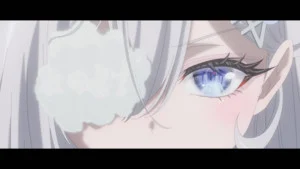
Journal with Witch’s sixth episode deepens what has already been a quietly powerful josei adaptation, giving Makio a threefold spotlight: an intimate look at neurodivergence in adulthood, a compassionate reading of a younger woman’s sexuality, and an uncommonly tender portrayal of female desire. This installment manages to be observant, warm, and sensual all at once—rare qualities in mainstream anime, and especially welcome in a series centering an adult woman navigating messy, real-life emotions.

Table of Contents
Makio and the Representation of Neurodivergence
One of the episode’s clearest achievements is how it frames Makio’s inner life in a way that feels authentic and compassionate. The script places us directly inside Makio’s head: her disorganization, absentmindedness, sensory overload, and the way she can tune conversations out without meaning to. While the show never offers a formal diagnosis, those traits read to many viewers as consistent with untreated ADHD or similar neurodivergent experiences.
What matters more than a label is the social fallout shown here. Little annoyances that friends tolerate add up, and the episode depicts how that accumulation strains Makio’s relationships. The montage of daily friction—yelling that triggers panic, the quickness of others to blame or correct—feels lived-in and true. Importantly, the storytelling invites empathy. Rather than making Makio the joke or the dramatic fulcrum, the adaptation insists we feel the sting of a lifetime of minor humiliations and misunderstandings from her point of view.
Language that matters
It’s telling that Makio doesn’t call herself “abnormal.” She calls the differences “obvious.” That linguistic shift is powerful: the gap between perception and expectation is foregrounded without medicalizing or diminishing her experience. The episode also shows how frustration can fade into tenderness; Asa notices Makio’s distress and softens, highlighting that even imperfect relationships can find workable empathy.
Reading Emiri: Subtext and Queer Sensitivity
The episode also uses Makio’s observational gifts to gently unspool Emiri’s subplot. Small beats—Emiri’s awkwardness when tea and marriage are mentioned, her noncommittal replies, and Makio’s intuitive sensitivity—build toward the strong implication that Emiri is a closeted lesbian wrestling with fear and possibility.
Rather than forcing a confrontation, Makio extends an older-aunt-level of support: she hands Emiri a copy of Fried Green Tomatoes. The gesture functions like a quiet coded message—an invitation into history and hope. For viewers who recognize the reference, the film’s lesbian storyline becomes a mirror and a lifeline. That kind of subtle signaling is deft: it gives Emiri room to process while making the show’s queer reading plainly compassionate.
Fried Green Tomatoes (film) is clearly the symbolic touchstone here—Makio’s offering suggests that a life lived honestly is possible even in hardship.
Female Desire, the Female Gaze, and Mature Intimacy
Where this episode truly stands out is its frank, intimate depiction of Makio’s sexual memory and longing. The date with Kasamachi is staged not as comedy or titillation, but as a slow-rolling rediscovery of attraction filtered through a mature female perspective. The camera work—tight zooms on hands, mouths, eyes, and peripheral gestures—creates a sensorial map of desire that centers Makio’s experience.
We see what Makio notices: the way he licks his lips, the tilt of his smile, the small muscle tensions in his neck and arms. Those details feel authentic because they’re rooted in curiosity and private memory, not in voyeurism. The public moments of casual PDA—hair touching, fingers running through a ponytail—are staged so tenderly they read almost like a shorthand for mutual familiarity. The kiss, built through deliberate editing and close-ups, lands as both sensual and emotionally truthful.
Why this matters for josei anime
Anime rarely grants adult women this level of interiority around desire. Male fantasies or teenage romance tropes often dominate visual storytelling, even in works aimed at grown-up audiences. Here, Journal with Witch treats a woman’s libido and longing as natural parts of her life, worthy of subtle, careful exploration. That alone makes this episode significant—not just as representation, but as an argument for the storytelling richness of josei material.
Adaptation Craft: Camera, Pacing, and Tone
The adaptation’s craft choices are worth noting. Editing and mise-en-scène put us inside Makio’s sensory flow: moments of overload are juxtaposed with still, longing beats that give the viewer room to breathe. The pacing doesn’t rush revelations; instead, it allows small domestic details to accumulate meaning. The result is an episode that feels intimate rather than expositional.
Moreover, the show balances humor and tenderness without undercutting either. Lighter, character-driven banter sits comfortably beside more vulnerable snapshots, and the tonal control helps the emotional moments land harder.
Where to Watch
Journal with Witch is currently streaming on Crunchyroll, where you can catch the full series and follow Makio’s evolving arc.
Final thoughts
Episode 6 of Journal with Witch is a standout for how it treats an adult woman’s interior life with intelligence and care. Between its compassionate handling of neurodivergent traits, its gentle queer subtext, and its rare, honest portrayal of female desire, the episode signals the unique strengths of josei storytelling—quiet, observant, and emotionally resonant. If you value anime that privilégies character depth over spectacle, this installment is a delicious, slow-brewed reminder of why those stories matter.