Dr. Stone: Science Future Episode 33 continues the series’ blend of inventive low-tech engineering and character-driven stakes. Senku sets out to “re-invent the internet,” while the Kingdom of Science prepares its three-person crew for a petrified voyage to the moon. The episode balances clever problem-solving and light-hearted sight gags with strategic maneuvering as endgame pieces are placed on the board.
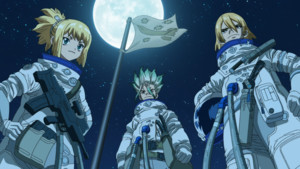
Table of Contents
Senku’s “Internet”: Ingenious, But Intentionally Low-Tech
Senku’s proclamation that he will “re-invent the internet” is classic Dr. Stone: audacious in scope but grounded in tangible, clever science. Rather than attempting to recreate our modern packet-switched, global IP network with servers, routers and satellites, Senku pursues a pragmatic workaround—direct underwater communications cables created using a hydrophobic, electrically insulating elastomer derived from the Eucommia rubber tree.
By insulating the metallic core from seawater and enabling long-distance electrical signal propagation, these cables act as point-to-point communication arteries. Given the scarcity of advanced electronics in the Stone World—where the SAL-9000 terminal represents one of the only computationally capable machines—Senku’s approach prioritizes what’s achievable: reliable, low-latency, bi-directional video and voice links that let remote teams collaborate in real time. In practice this functions more like a primitive, wide-area two-way television network than what we think of as the internet.
Undersea Cables vs. Satellites: A Practical Choice
Without satellites or sophisticated radio infrastructure, laying physical cables is the most straightforward way to transmit high-fidelity audiovisual signals across oceans. For a readable primer on how real-world submarine communications cables work, see this Britannica overview (Submarine communications cable — Britannica).
Dr. Stone smartly leans into CRT-based terminals, phosphor pens for on-screen annotation, and repeaters that don’t require contemporary silicon miracles. It’s an elegant solution: low-tech components combined in a system that leverages human ingenuity and available natural materials. The show deliberately avoids turning the moment into a lecture on the huge labor and logistics required, but the narrative payoff—instant global collaboration between multiple scientific teams—is satisfying and visually fun.
Technical Limits and Narrative Convenience
That said, the episode glosses over several real-world practicalities. The SAL-9000’s computing power is likened to an early 1980s games console, and without modern endpoints to handle internet protocols, the “network” on display is closer to a mediated broadcast chain than a packet-switched environment. Also, hand-laying transcontinental cable across oceans would be staggeringly time-consuming in reality; the show asks viewers to accept that Senku now commands nearly unlimited fabrication resources and a worldwide army of willing collaborators.
But Dr. Stone has always traded absolute realism for the joy of plausible innovation. These narrative shortcuts keep the pacing brisk and maintain the series’ tone: a celebration of science-driven creativity rather than a detailed logistics exposé.
Choosing the Moon Crew: Strategy Meets Character
The episode largely revolves around picking the three people who will travel—petrified—to the moon. From a tactical perspective, the discussion raises good questions about what skills are indispensable for such a mission.
Candidate Breakdown
- Senku: The mastermind and scientific brain of the Kingdom, indispensable for mission planning but physically frail and low on endurance.
- Tsukasa: A powerhouse physically, with battlefield experience and raw strength that make him an obvious bodyguard choice.
- Kohaku: Compact, agile and deadly in close combat—her lightweight build makes her an attractive bodyguard option where weight and mobility matter.
- Ryusui: The ace pilot and excellent marksmanship—proven in simulated tests and useful for any situation demanding precision.
- Chrome: Resourceful, physically fit and a scientific mind honed in the field—arguably a dark horse choice who bridges brains and brawn.
- Stanley (petrified): A wildcard whose release would bring a powerful but morally ambiguous agent back into play—raising narrative tension about risk vs. reward.
On-screen interactions underscore the emotional and interpersonal dynamics behind the choice. Tsukasa’s clumsy, almost-proposal-style attack on Kohaku reads as a non-verbal way of measuring suitability—an example of how the series layers character beats into plot logistics. Ryusui’s piloting prowess makes him a natural candidate, but the possibility of freeing Stanley reveals a deeper strategic dilemma: do you rely on proven loyalty, or reintroduce a volatile asset for the mission’s success?
Tone, Visuals, and Pacing
Episode 33 is a reminder that Dr. Stone works best when it keeps things bright, breezy and inventive. The animation maintains clean, colorful production values, and the episode sprinkles sight gags and small visual jokes to offset the heavier strategic conversations. These moments of levity—like crude CRT scribbles with phosphor pens or over-the-top weapon demonstrations—help the pacing and remind viewers not to treat every plot beat as dire or somber.
While not every episode needs to be deeply emotional or transformative, this installment performs the necessary role of advancing the endgame: building infrastructure, aligning allies, and deciding who carries humanity’s hope to the stars. It’s methodical and enjoyable, even if it sometimes skips over the herculean effort those feats would require in real life.
Where to Watch
Dr. STONE: Science Future is available for streaming on Crunchyroll (Watch on Crunchyroll).
Final thoughts
Episode 33 is a solid, workmanlike installment that highlights what makes Dr. Stone appealing: imaginative science, charismatic characters and a healthy dose of optimism. It trades deep technical realism for practical creativity, which keeps the story moving and the stakes clear. As the series lines up players for the next big play, the tension between brains, brawn and moral ambiguity sharpens—promising a compelling set of confrontations and discoveries to come.