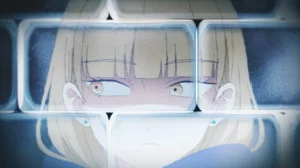
Episode 4 of Roll Over and Die tries to juggle body-horror, slapstick, and sapphic romance — and comes away feeling uneven. The installment starts with a muddled descent into an underground lab that often feels visually and narratively disjointed, then pivots into stronger character work late in the episode. For fans of queer-driven character dynamics, the payoff in the back half redeems much of the rough first act, but the adaptation’s tonal whiplash is hard to ignore.

Table of Contents
Visuals and World-Building: A Lab That Doesn’t Hold Together
The episode’s opening environment work is a rare misstep. The lab sequences hop between contrasting aesthetics — a spooky cave, vats of neon goo, a corpse disposal pit, and a sterile white room — without any sense of cohesion. When background design feels like a collage of unrelated sets, it pulls viewers out of the moment. Disparate textures and tones can be used intentionally for an unsettling atmosphere, but here the effect reads as unfinished or rushed rather than artful.
When exposition interrupts the visual story
Another jarring choice is the show’s habit of narrating what the audience already sees. The narrator’s explanations about visible anomalies (like the spiral afflicting a character’s face) replace what could have been eerie visual storytelling. In animation, “showing” usually has greater impact than “telling,” and this episode repeatedly opts for the latter — often to comedic effect, albeit unintentionally.
Tone and Execution: Horror vs. Slapstick
There’s an odd tension between attempts at body-horror and moments that play like cartoon gags. Scenes that could have been legitimately chilling — a faceless woman sucking in a character’s hand or a macabre fall into a pile of corpses — are edited and staged for laughs instead of dread. Rather than leaning fully into either horror or comedy, the episode oscillates, creating an unpredictable viewing experience that may delight some viewers and frustrate others.
Intentional goofiness?
At times it feels as if the adaptation embraces silliness on purpose. A line like “I can’t ask a nun to rob corpses” lands with such deadpan timing that it reframes grotesque circumstances into dark humor. The mix of tones suggests a show not quite sure what it wants to be, but willing to let genre friction generate oddball moments.
Character Moments: Flum, Milkit, and the Power of Memory
The episode’s strongest material arrives once plot momentum returns in the second half. Flum’s flashbacks to her former party members function as more than cheap recycling of past beats; they’re integrated into her struggle, supplying emotional fuel at a key moment. The device makes Flum feel like a character shaped by continuity rather than a reset at every episode — her past bonds and betrayals continue to inform who she is.
Milkit’s presence becomes pivotal when Flum draws strength from her feelings to topple a cursed ogre. The subtitles’ phrasing — that Flum fights “with” her love — nicely reinforces the theme that love can be a source of power, not just motivation. That said, Milkit herself remains relatively underdeveloped onscreen and would benefit from a clearer arc so the emotional stakes around the pair feel earned rather than convenient.
Sara and Neigass: A compelling secondary pairing
One of the episode’s most enjoyable elements is the rapid development of the Sara–Neigass dynamic. A nun paired with a demon, transitioning from antagonism toward romance, delivers classic opposites-attract chemistry. Secondary ships like this often outshine the main pairing in many shows, and Sara and Neigass already show signs of offering an engaging, complementary subplot full of mutual awkwardness and unexpected tenderness.
Moral Ambiguity: Demons vs. The Church
A significant thematic pivot emerges in episode 4: demons start to feel like the lesser evil. The demons demonstrate a code that prevents wanton killing of humans, whereas the Church is shown to have amassed a literal pit of bodies in pursuit of rituals that create violent, eldritch monstrosities. The narrative pushes viewers to question traditional allegiances and reevaluate who deserves sympathy — an intriguing shift that adds moral complexity to the series.
Pacing: A Tale of Two Halves
Pacing is the episode’s defining structural issue. The first half meanders and stalls the narrative with muddled set pieces and tonal inconsistencies. When the momentum returns, though, the episode earns its runtime through character beats, a satisfying fight, and subtle yuri cues that will please romance-minded viewers. In short: patience through a sluggish first act is rewarded by an emotionally satisfying second act.
Where adaptation succeeds and where it falters
Where the adaptation succeeds is in character-focused payoff and the effective use of emotional memory. Where it falters is in its inconsistent visual identity and tendency to narrate rather than dramatize. These are not fatal flaws, but they do limit the episode from being as haunting or as seamless as it could have been.
Where to watch
Roll Over and Die is available for streaming on Crunchyroll for many regions. Watch on Crunchyroll. For additional community info and episode listings, you can also consult the series entry on MyAnimeList. MyAnimeList.
Final thoughts
Episode 4 of Roll Over and Die is a mixed bag: visually inconsistent and tonally uneven in its opening stretches, yet emotionally resonant and surprisingly effective by the finale. Fans of yuri elements and morally ambiguous storytelling will find enough here to stay engaged, particularly thanks to the growing chemistry between characters like Flum and Milkit and the delightful Sara–Neigass subplot. If the series can smooth out its aesthetic choices and trust its quieter moments more, it has room to become a consistently rewarding watch. For now, the show remains uneven but entertaining — imperfect, but with sparks that could become something sharper.