Episode 11 of The Holy Grail of Eris accelerates the story into near-meltdown territory: secrets unravel, loyalties are tested, and the show forces its characters into stark, revealing moments. What began as a slow-burn character drama has turned into a high-stakes, emotionally fraught countdown. With Connie’s execution looming and power plays collapsing around her, this installment asks whether people are truly who they present themselves to be — and whether masks can survive the heat of consequence.
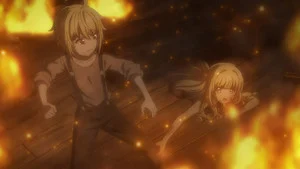
Table of Contents
Constance and Scarlett: Two Sides of Courage
A major emotional thread of this episode is the relationship between Constance (Connie) and the spectral Scarlett. The episode reframes a key rescue from earlier in the series: Brenda — the girl from the ball — insists Constance saved her, even though Scarlett was the active force at the time. That contradiction isn’t a simple misremembering; it’s an illustration of how identity and agency blur in the series.
Scarlett’s interventions have always been brusque and theatrical, but the show repeatedly makes the case that Scarlett’s influence simply surfaces traits Constance already possesses. In other words, Scarlett is a catalyst, not a puppetmaster. When Connie acts bravely now — refusing to take the easy way out, confessing or breaking her engagement to protect others — those actions feel authentic to her character arc. Episode 11 emphasizes that bravery can be doubled: one part fearless instinct (Scarlett), one part sincere moral compass (Constance).
Masks Slipping: Who’s Hiding What?
Another central motif is deception. This episode peels back several façades at once. Cecilia’s calculated schemes begin to crack, revealing motives and histories that complicate our understanding of the noble house politics. Even secondary figures — like Viscount Hammsworth — are given texture: while morally dubious, the Viscount is refreshingly consistent. He acts for himself and wears his self-interest plainly, which makes him a strangely reliable benchmark amid duplicitous nobles.
The problem of revealing too much, too fast
The series’ pacing problem becomes most visible here. As we race toward the finale, multiple backstories and conspiracies are dumped into a short span: Cecilia’s true origins, the Farisian princess plot, and the layered betrayals surrounding Connie’s case. While each revelation is compelling on its own, presented together they reduce the emotional breathing room the show once allowed. Character beats that previously developed over several episodes now happen within minutes, which can blunt the impact of major twists.
Lucia: A Child Who Upends Adult Power
One of the episode’s most striking developments involves Lucia, who might be small in stature but is massive in narrative significance. Lucia’s fierce protection of Ulysses and her willingness to put herself in harm’s way make her a formidable political player — or at least a symbolic threat to the powers-that-be. The fact that Cecilia’s minions consider her expendable enough to kill is chilling: it highlights the ruthlessness of the court and the extent to which innocence is politicized in this world.
Lucia’s arc raises a recurring story question: what makes someone dangerous? In this narrative, danger is less about martial skill and more about what a person represents — a disruption of comfortable narratives, a living contradiction to the established order. Lucia embodies that disruption.
Enrique, Family, and the Weight of Guilt
The episode hints strongly that Enrique may have chosen death as penance for a past atrocity. If true, his fate ties into the series’ obsession with accountability and the impossibility of fully escaping past sins. Connie’s father, on the other hand, has a small yet powerful moment: he refuses to renounce his daughter, demonstrating a form of stubborn sincerity that contrasts with the many hypocrites around them. These parental dynamics add emotional depth to the ticking-clock plot.
The grail as metaphor
The goddess of discord’s grail remains a potent symbol. Is it destined to be filled with blood, representing an unending cycle of revenge and sacrifice? Or will someone disrupt that fate and end the cycle? Episode 11 leans into the medieval, ritualistic stakes of the story: the grail is not just a MacGuffin but a moral barometer. Its state reflects whether the characters choose reconciliation or retribution.
Pacing and Narrative Choices: Strengths and Weaknesses
There are trade-offs to the compressed storytelling: the final episodes hum with tension and deliver a cascade of dramatic beats, which is thrilling. But the speed also means some characters receive shorter payoffs than they deserve. Minor figures like Lucia get powerful, concise moments, but other secondary characters are flattened by rapid reveals. The writing occasionally favors plot propulsion over nuanced emotional progression.
Stylistically, the episode retains strong visuals and effective tonal shifts — quiet, tender moments contrast nicely with sudden, brutal political decisions. Still, fans who appreciated early episodes’ slower character work may find the rush to the climax unsatisfying in places.
Where to Watch
The Holy Grail of Eris is available to stream on Crunchyroll. For more details about the series, its cast, and episode listings, check the official streaming page.
Watch on Crunchyroll (nofollow) | Series info on MyAnimeList (nofollow)
Final thoughts
Episode 11 of The Holy Grail of Eris is a pressure cooker — intense, revealing, and emotionally risky. It delivers meaningful character moments and high-stakes political drama, but at the cost of compressing several arcs into a narrow window. The result is a thrilling penultimate push that sometimes sacrifices subtlety for momentum. Still, the episode succeeds at making the stakes feel real: lives are about to change irrevocably, and the series forces viewers to ask whether bravery, truth, and identity can survive when everything else is collapsing. If the finale can balance payoff with emotional clarity, this rushed chapter will feel like the necessary ignition that sets the ending ablaze.