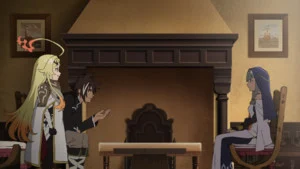
The fifth episode of Medalist Season 2 shifts focus from Inori’s competitive arc to revisit Tsukasa’s complicated past and his evolving relationship with Jun. Rather than a straight continuation of tournament fallout, this installment uses a quiet reunion and a private skate to probe Tsukasa’s unresolved regrets, his reasons for abandoning a pro career, and whether coaching Inori is truly the redemption he believes it to be. The episode delivers a thoughtful character beat, raises narrative stakes for both mentor and student, and teases a more direct confrontation between Inori and Hikaru on the ice.
Table of Contents
Episode 5 Overview: A Reunion That Redefines
Episode 5 opens by picking up threads from the previous week and steering them toward a quieter, character-focused moment: Tsukasa finally comes face-to-face with Jun. The meeting is awkward—Jun doesn’t recognize him, which underlines how much time and distance exists between their shared history—but the emotional core emerges once the three of them skate together in private. This setting lets the show juxtapose past versus present: Jun’s regained form against Tsukasa’s lingering uncertainty and the way each man now frames success.
Tsukasa vs. Jun: Talent, Pride, and Regret
What could have been a simple pride-driven rivalry crescendos into something more reflective. Tsukasa, out of practice with regular skates, initially looks awkward—but quickly regains his footing and surprises Jun with a level of resilience and raw talent that still lingers beneath the surface. Instead of sparking animosity, Tsukasa’s performance elicits genuine admiration from Jun and a pointed question: why did Tsukasa walk away from a pro career?
Why this scene matters
The exchange accomplishes two things. First, it exposes the heart of Tsukasa’s internal conflict: he’s committed to Inori’s development, but coaching has become a safe space that lets him avoid confronting a painful past. Second, it reframes the stakes—this isn’t only Inori’s coming-of-age story; it’s a shared journey that forces Tsukasa to reckon with whether helping someone else succeed is the same as healing himself.
Character Work: Coaching as Comfort or Coercion?
Medalist has steadily balanced Inori’s rise with Tsukasa’s backstory, and this episode deepens that balance. Tsukasa’s declaration that he’s chosen to be Inori’s coach comes from a place of sincerity, but the show cleverly suggests that it’s also a coping mechanism. Training Inori gives him purpose, but it may also be a way to avoid the vulnerability of stepping back into the spotlight or accepting past failures.
Two plausible paths for Tsukasa
- Return to competition: The scene with Jun plants seeds for a possible pro comeback, either to face unresolved regrets or to prove something to himself.
- Commit to coaching: Alternatively, Tsukasa could fully embrace mentoring as his way of legacy-building, making peace with his past through Inori’s growth rather than his own professional revival.
Both outcomes feel narratively honest, which is the show’s strength: Tsukasa’s arc can evolve naturally in either direction without betraying his characterization.
Inori and Hikaru: The Next Phase of Training
One trade-off in this episode is reduced Inori screen time. Her role here is pragmatic—she’s starting the next round of training—but the episode still sets up an important development: Hikaru is attending the same sessions, and a direct comparison between Inori and Hikaru is imminent. Given Tsukasa’s recent eye-opening skate with Jun, it’s fitting that Inori will soon see firsthand what she’s up against. The upcoming head-to-head—likely not a dramatic duel, but a measuring of skill and style—will show how training philosophies and raw talent intersect on the ice.
Animation, Direction, and Tone
Episode 5 opts for a quieter directorial approach, favoring intimate staging over big-venue spectacle. The private skate scene highlights fluid motion and subtle expressions—prime territory for an animation team that knows how to convey unspoken emotion through glide lines and small gestures. Pacing is deliberate here, which may frustrate viewers hungry for competition scenes but elevates the show’s emotional realism.
Use of sports anime tropes
Medalist doesn’t shy away from classic sports-anime beats—rivalry, mentorship, training montages—but it reframes them through mature character work. Instead of pure shonen energy, the series leans into reflective drama: talent is shown as both gift and burden, and victories are measured in personal reconciliations as much as medals.
What This Episode Signals for the Season
By devoting time to Tsukasa’s unresolved story, Episode 5 broadens the series’ thematic reach. The show hints that the season won’t be a linear ascent to victory for Inori; it will also be about the adults shaping her path. Tsukasa’s confrontation with the past and the possibility of a professional return add complexity to the stakes: Inori’s growth could inadvertently catalyze Tsukasa’s own transformation, for better or worse.
Predictions
- Tsukasa may face a choice that forces him back onto the competitive stage, either temporarily or fully.
- Inori and Hikaru’s dynamic will become a central rivalry that helps define Inori’s technical and emotional maturation.
- The show will continue to explore mentorship as a two-way street—Inori pushes Tsukasa to heal while he gives her the foundation she needs to grow.
Where to Watch
Medalist Season 2 is currently available on streaming platforms. You can find it on Hulu and Disney+. For convenience, here’s a link to Hulu (external): Watch Medalist on Hulu. (Please note availability may vary by region.)
Final thoughts
Episode 5 of Medalist Season 2 slows the competitive tempo to spotlight a meaningful character beat: Tsukasa’s reunion with Jun forces introspection about talent, choice, and what it means to move on. The episode smartly balances quiet emotional work with setup for future confrontations—Inori’s training intensifies and Hikaru’s presence promises a new measuring stick. While some viewers may miss more on-ice spectacle this week, the episode’s reward is a deeper, more resonant story for both coach and student. Whether Tsukasa ultimately returns to competition or commits fully to coaching, the series continues to treat its characters with nuance, making every skate and conversation feel earned.