The beloved investigative manga Tokyo Salad Bowl returns with a direct sequel: Tokyo Salad Bowl 2nd dish: Keishichō-hen (Tokyo Salad Bowl 2nd dish: Metropolitan Police Department Arc). Launched on Kodansha’s Comic Days platform, this new installment continues Kuromaru’s gritty, realistic look at international crime in modern Tokyo — this time zooming in on the Metropolitan Police Department and its tangled dealings with foreign nationals and cross-border criminal organizations.
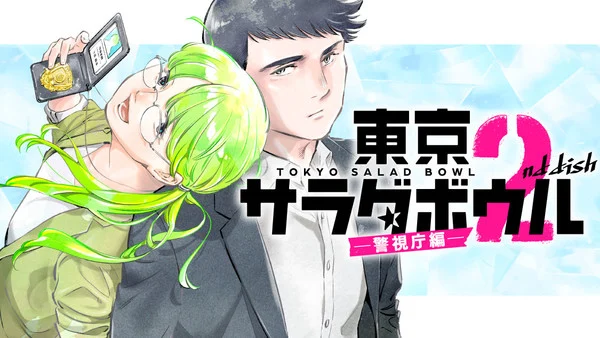
Table of Contents
What Is “Tokyo Salad Bowl 2nd dish”?
Tokyo Salad Bowl 2nd dish: Keishichō-hen is the official sequel to Kuromaru’s original Tokyo Salad Bowl manga. The new arc continues the series’ trademark focus on realistic, procedural storytelling — following law enforcement as they investigate crimes with international ties that play out against the backdrop of Tokyo’s multicultural neighborhoods. Expect the same hard-edged tone, social commentary, and character-driven mysteries that made the first series resonate with readers.
Core Characters: Mari Kōda and Ryō Arikino
The sequel keeps the story centered on the unlikely investigative pairing of Mari Kōda, a green-haired Metropolitan Police officer, and Ryō Arikino, a skilled police interpreter. Their dynamic — a balance of streetwise police instincts and linguistic/cultural mediation — drives the series’ investigative approach. Together, they peel back the layers of cases that involve foreign nationals, smuggling networks, and multinational crime rings, exposing how global issues manifest locally in Tokyo.
Publication History and Where the Sequel Fits
The original Tokyo Salad Bowl began on Kodansha’s Palcy app in 2021 and concluded with a fifth compiled volume shipped in 2024. Building on that foundation, Kuromaru’s sequel began serialization on Kodansha’s Comic Days site. The 2nd dish explicitly expands the scope to the Metropolitan Police Department, offering a natural escalation in scale and institutional complexity compared with the first series.
For readers who enjoyed the tightly plotted, socially aware mysteries of the original run, the sequel promises more of the same — but with higher stakes and a closer look at how official institutions respond to crimes with international implications.
Why the Sequel Matters: Themes and Relevance
Tokyo Salad Bowl stands out for its contemporary realism and refusal to romanticize crime. Rather than stylized action, Kuromaru’s work emphasizes procedural detail, language barriers, and cultural friction — elements that make the story feel timely and relevant in an increasingly globalized city. The Metropolitan Police Department arc deepens this perspective by examining how institutional structures handle intercultural incidents, and how bureaucracy and public perception influence investigations.
Social Commentary Through Crime Fiction
Beyond its puzzle-box mysteries, the series functions as social commentary. It highlights the experiences of foreigners in Japan, explores the gray zones between legal and illegal activities in cosmopolitan spaces, and questions how justice is pursued when different legal systems, languages, and cultural expectations collide.
Adaptations and the Franchise Legacy
Tokyo Salad Bowl’s first manga inspired a live-action television adaptation that aired on NHK in January 2025, increasing the franchise’s visibility beyond manga readers and bringing the series’ realistic tone to a wider audience. The live-action reception helped reinforce the brand’s identity as grounded, character-driven crime drama and paved the way for continued interest in sequels and related projects.
Kuromaru’s work also shares creative lineage with other crime-focused manga — notably Takeshi Natsuhara and Kuromaru’s 2004 title Kurosagi: The Black Swindler, which similarly received multiple live-action adaptations. That track record demonstrates a consistent appetite for realistic, investigative storytelling that translates well across media.
Where to Read and Watch
Tokyo Salad Bowl 2nd dish launched on Comic Days. You can view the sequel’s serialization on the Comic Days site. For viewers who prefer the live-action version of the original manga, the NHK adaptation is available (regional availability varies), and streaming of the earlier live-action series has been carried on platforms such as Amazon Prime Video. For direct reading of the manga or streaming availability, check the official Comic Days page and authorized streaming platforms for your region. Read the sequel at Comic Days.
What Fans Should Expect Next
Readers can expect the sequel to continue delivering morally complex cases and an emphasis on realistic investigatory procedure. With the Metropolitan Police Department in focus, storylines may shift to larger institutional conflicts, corruption investigations, and cases that require extensive coordination with foreign law enforcement — all of which can enrich the series’ scope and character development.
Potential Story Directions
- Deeper exploration of bureaucratic and political obstacles inside the Metropolitan Police Department.
- Expanded roles for interpreters and cultural mediators as essential components of investigations.
- Cases that link domestic crimes to broader international networks, increasing narrative stakes.
SEO Notes & Keywords
Primary keywords used in this post: Tokyo Salad Bowl 2nd dish, Kuromaru, Mari Kōda, Ryō Arikino, Comic Days, Metropolitan Police Department arc, live-action adaptation, NHK, Amazon Prime Video. These terms are woven into headings and body text to support search discoverability for readers looking for updates on the sequel and related adaptations.
Final Thoughts
Tokyo Salad Bowl 2nd dish: Keishichō-hen is a welcome continuation for fans of Kuromaru’s grounded crime storytelling. By focusing on the Metropolitan Police Department and retaining the series’ interest in language, culture, and institutional complexity, the sequel promises deeper, higher-stakes mysteries that reflect Tokyo’s evolving social landscape. Whether you discovered the story through the original manga or the NHK live-action adaptation, the 2nd dish is shaping up to be a must-read for anyone who prefers crime fiction that engages with real-world issues and procedural nuance.
Check streaming availability on Amazon Prime Video