Table of Contents
You Can’t Be In a Rom‑Com with Your Childhood Friends! — Series Review
Romantic comedies love their set pieces: misunderstandings, accidental embraces, and that lingering question of whether people who grew up together can ever become lovers. You Can’t Be In a Rom‑Com with Your Childhood Friends! leans into those familiar beats from the very first scene, serving up self‑aware gags and manufactured romantic setups while asking whether nostalgia and familiarity are enough to carry a sincere love story. The show delivers a handful of chuckle‑worthy moments but struggles to find a consistent tonal center or to make its character dynamics feel earned.
Synopsis
Yonosuke Sakai is an avid reader of romantic comedy manga who believes those exaggerated scenarios could never happen in real life — but life has a way of imitating fiction. Surrounded by multiple childhood friends, Yonosuke repeatedly finds himself in awkward, tropey situations that look suspiciously like rom‑com setups. As the group navigates stunts, miscommunications, and deliberate attempts to recreate romantic moments, the show asks whether these shared histories can realistically progress into something more than friendship.
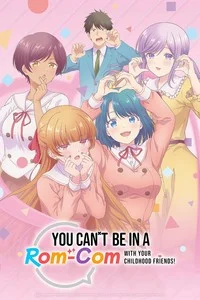
Official artwork — a rom‑com that constantly plays with its own clichés.
Tone and Trope Awareness
The series opens confidently as a self‑aware parody: it pokes fun at rom‑com conventions and leans into absurdity. Early sequences are snappy and comedic, with direction that highlights the exaggerated nature of each setup. Those moments are where the show is at its best — they acknowledge the audience’s expectation and subvert it just enough to earn a laugh.
That promise starts to fray once the show vacillates between parody and earnest drama. When the script asks viewers to invest emotionally, the show often undermines that investment with contrived misunderstandings and a stubborn commitment to maintaining the status quo. The result is tonal whiplash: one episode will lampoon the genre, the next will expect you to care deeply about a confession that feels engineered rather than grown from character work.
Characters: Familiar Archetypes, Limited Growth
The central cast reads like a checklist of rom‑com archetypes: the dependable girl‑next‑door, the tsundere, the adorable “little sister” type, and the tomboy. Each character receives individual moments and short arcs, but the writing rarely elevates them beyond their initial templates. Because the plot frequently resets or avoids resolving romantic beats, the characters’ development stalls; their histories are referenced, but those histories rarely lead to meaningful change.
Yonosuke functions as a believable nervous teen — awkward, hopeful, and frequently misread by the people around him. That sincerity could be the show’s anchor, except the supporting characters sometimes act in ways that feel like obstacles for drama’s sake rather than natural personality conflicts. When the series chooses to prolong tension through poor communication, the audience is asked to tolerate frustration rather than be rewarded with satisfying growth.
When the Gimmick Works — and When It Doesn’t
There are moments when the premise pays off: staged romantic scenarios that land as clever meta‑jokes, or brief scenes in which the cast’s shared history produces genuine intimacy. But those highs are too infrequent and often reversed quickly by the series’ reluctance to follow through. If you enjoy the idea of a rom‑com that intentionally plays chicken with its audience — teasing progress and then pulling back — you might find some perverse entertainment here. If you prefer your romantic beats to advance naturally, this will likely frustrate you.
Presentation: Visuals and Sound
Visually, the show is mixed. Many scenes are bright and clean, but the overall palette often skews toward a washed‑out white glow and frequent romantic filters that can feel overused or heavy‑handed. Those effects sometimes distract more than they enhance, making tender moments look blurred rather than beautiful. The direction is competent in comedic beats but rarely adventurous in emotional scenes.
The soundtrack follows a similar pattern: occasional pleasant guitar pieces and a handful of memorable cues are offset by choices that over‑punctuate moments with strings or dramatic arrangements that feel ill‑fitted. Overall, the audiovisual design complements the show’s middling execution — competent at times, obtrusive at others.
English Dub and Voice Performances
The English dub offers a slight advantage in comedic timing; some performances lean into exaggeration and land jokes more effectively than the original track in a few scenes. That said, the dub doesn’t fundamentally change the series’ weaknesses. When dialogue is structural padding rather than meaningful exchange, a stronger performance can only do so much.
Who This Series Is For
This series will likely satisfy viewers who enjoy genre‑savvy rom‑coms and are comfortable with unresolved tension as a recurring gag. If you like quick meta‑jokes, trope deconstruction, and a willingness to keep characters in a perpetual status quo for comedic effect, give it a try. If you come for substantive character growth or emotionally rewarding romantic payoffs, you’ll probably leave disappointed.
Final thoughts
You Can’t Be In a Rom‑Com with Your Childhood Friends! starts with a fun premise and the occasional clever joke, but it’s ultimately hamstrung by inconsistent tone, archetypal characters that rarely evolve, and presentation choices that distract rather than elevate. The series is watchable in small doses if you enjoy rom‑com parody, but it overstays its gimmick and resists the very progress it teases. For viewers seeking a romantic comedy that both laughs at and earns its emotional beats, there are better options this season — this one is a mixed bag that leans toward the forgettable.