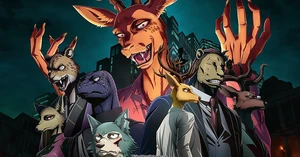
Studio Orange’s BEASTARS Final Season Part 2 brings Legoshi, Haru, Louis and the rest of the anthropomorphic cast back for a tense, character-driven finale that leans hard into identity, desire and the moral compromises a divided society requires. The show swings between thoughtful scene work and sudden bursts of violence, delivering memorable villainy in Melon while leaving some of its broader thematic questions only partially explored.
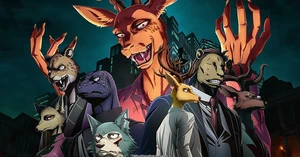
BEASTARS Final Season Part 2 key visual.
Table of Contents
Synopsis — Stakes, Survival, and a City on Edge
After a near-death confrontation with Melon, a mixed-species individual with a terrifying agenda, Legoshi survives and doubles down on bringing Melon to justice. The series frames Legoshi’s pursuit as more than a personal vendetta: capturing Melon is presented as a civic act that might allow Legoshi to pursue a future with Haru despite the stigma around his devourer status. Meanwhile Louis contends with inheriting his father’s influence at the Horns Conglomerate and the ever-present tensions between political power and personal longing. As the city’s fragile social order strains under both overt violence and quiet prejudice, the show asks what it truly takes to live together.
Characters & Voice Performances
Melon — A Disturbing Mirror
Melon stands out as the season’s most compelling and unnerving presence. As a mixed-species antagonist, he acts as a warped reflection of Legoshi’s own internal conflicts: where Legoshi is hesitant and introspective, Melon is theatrical, self-destructive and gleefully cruel. The character’s complexity — self-hatred, curiosity twisted into cruelty, and a performative nihilism — makes him steal nearly every scene he occupies.
Legoshi, Haru & Louis — Growth, Intimacy, and Ambiguity
Part 2 gives Haru and Legoshi more interwoven moments, portraying them as a couple aware of the impossibility of their relationship and yet still determined to try. Haru receives more agency here than in earlier seasons, and her emotional beats feel more pronounced. Louis’s arc continues to interrogate the limits of public power versus private desire, and his political navigation adds a layered counterpoint to Legoshi’s more personal journey.
Adaptation Choices & Pacing
Fans of the manga will notice clear deviations: the anime compresses, shuffles and occasionally omits beats. Many of these changes work in service of tightened drama, but the compressed format can make the climax feel hurried. The season excels at giving side characters room to breathe in quieter stretches, deepening the world through smaller vignettes, yet when the story ramps toward its final confrontation the pacing accelerates abruptly. Several subplots and romantic threads that promised payoff end up feeling unresolved or vague — a consequence of limited episode real estate that ultimately leaves a few narrative opportunities underused.
Themes — Society, Desire, and Double Standards
BEASTARS has always been strongest when it examines how social structures enforce hypocrisy and inequality through species-based hierarchies. This final part continues that interrogation, showing how necessary evils and moral compromises are baked into the city’s functioning. The series highlights how desire, identity and institutional pressure collide in individual lives, and it frequently asks whether harmony is achieved or merely enforced. While several provocative questions are raised — about what to do with people like Melon, or how communities reconcile difference — not all receive the deep exploration they deserve.
Presentation — Visuals, Choreography & Music
Studio Orange’s character acting remains a highlight: movements are weighty, often awkward in ways that emphasize the characters’ animal bodies inhabiting human situations. The animation favors realism over slick choreography, which suits the show’s unsettling blend of the familiar and the strange. This final part ramps up action to a degree, and though set-pieces rarely reach the kinetic peak of season two, the combat and confrontations feel grounded and consequential.
The sound design and score continue to elevate mood — jazzy, brassy motifs underscore tense political moments while softer themes highlight intimacy between characters. The main leitmotif still lingers after the credits, a sign of how well the series uses music to define tone.
English Dub Notes
The English dub maintains strong leads and dramatic clarity, with a few standout performances that give life to the season’s more extreme emotional swings. There are occasional instances of double-casting among background roles that can be mildly distracting given the cast’s large ensemble, but the principal performances remain compelling and effective.
Where the Season Succeeds — And Where It Stumbles
The season succeeds in character moments: it gives supporting players meaningful scenes, crafts a memorable villain in Melon, and makes the central relationship between Legoshi and Haru feel earned in quieter beats. The series’ worldbuilding — its social codes, hypocrisies and small cruelties — remains thought-provoking.
Its stumbles are chiefly structural. The finale’s rush leaves thematic loose ends and underdeveloped plotlines. A longer epilogue or an extra episode or two would have allowed denouement to land more fully and offered viewers a clearer sense of consequences for several key characters.
Further Reading
For readers who want to learn more about the production studio or the manga’s creator, see Studio Orange’s official information and the creator’s profile. Beastars on Wikipedia and Paru Itagaki (creator) on Wikipedia provide helpful overviews and background.
Final thoughts
BEASTARS Final Season Part 2 is a fitting end for many of the show’s characters and themes: it’s bold with its character work, haunting in its villainy, and often moving in its quieter moments. However, a sense of urgency in the finale and compressed adaptation choices leave the series feeling like it could have used a little more time to unpack its biggest ideas. Still, the journey is worth it for anyone who appreciates character-first drama, morally gray storytelling, and an audacious visual identity. The finale may not fully satisfy every narrative thread, but it secures BEASTARS’ place as a singular and memorable drama in recent anime.