Roll Over and Die episode 10 plunges the show into a hazy, introspective hour that leans heavily on atmosphere and character beats rather than action. Director choices favor mood over clarity, and that creative gamble results in an episode that is thematically rich but uneven in execution. Below I break down the episode’s thematic focus, character arcs, pacing issues, and what the clues dropped here might mean for Flum’s confrontation with Dein.
Table of Contents
Episode Overview: fog, fear, and fractured trust
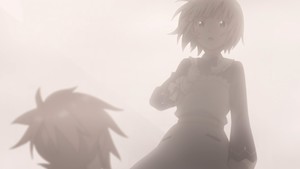
This episode chooses to saturate its visuals with thick fog that permeates the setting and mirrors Flum’s inner turmoil. On the surface, the plot advances through a series of disappearances and the reveal that Ink’s curse is tied to the killer eyeballs haunting the city. Emotionally, it’s Flum’s nadir: friends vanish, secrets emerge, and the ending sequence replaces the usual warm ensemble meal with a lonely, haze-bound Flum. The result is an intentional tonal shift toward darker, introspective storytelling.
Fog as a deliberate narrative device
Visually muffling the episode with fog is a bold stylistic choice. In theory it works: the weather reflects Flum’s confusion and disorientation, and it creates a tangible sense of obscured truths. But the execution often feels heavy-handed. Instead of using fog to selectively obscure key details and heighten tension, the episode largely turns the whole frame grey, which can dilute visual storytelling and leave viewers longing for more distinct imagery or symbolic framing.
When atmosphere becomes a crutch
Fog should be a tool to enhance emotional beats, not cover for weak transitions. Here it sometimes reads like visual padding—an attempt to suggest mystery without committing to a clearer cinematic language. A subtler approach or more inventive cinematography could have amplified the episode’s mood without sacrificing viewer engagement.
Flum’s emotional low point: believable but abrupt
At the heart of the episode is Flum’s self-blame. As her companions begin to vanish, her instinct is to assume responsibility. This is emotionally resonant: Flum’s insecurity and fear of being a burden are well-established, and the show leans into those vulnerabilities. The scene work that underscores her guilt is effective at communicating how deeply she internalizes responsibility for others’ safety.
Too fast to land fully
Where the episode stumbles is pacing. Flum’s descent into despair feels sudden—less an earned progression than a rapid escalation. The series hints at growing pressure in prior episodes, but this installment tries to do a lot of emotional heavy lifting in a short runtime. Showing the erosion of trust and hope across a stretch of scenes would have given her collapse more weight and made subsequent moments (like Milkit’s rescue) feel earned rather than convenient.
Character dynamics and important reveals
Despite pacing issues, there are several satisfying character beats. The parallel between Ink and Milkit’s backstories is a smart touch: Ink’s claim of amnesia is undercut by clues that suggest she’s been hiding parts of her past. That adds complexity to Ink and reframes her relationship with Flum—Ink isn’t merely a mysterious victim but someone with agency and secrets.
Welcy’s brief return is efficient and purposeful. Her observation about battle-scarred alleys and her hint regarding Ink’s “mother” are concise worldbuilding moments that provide useful context without slowing the episode down. Milkit’s role here is crucial; she acts as both literal and emotional savior for Flum, pulling her out of the spiral of catastrophizing and reaffirming the bond between them.
Pacing and narrative friction: the good kind
One of the episode’s strengths is that Flum does not instantly master magic or overcome her limitations. The series resists the easy route of rapid power progression and instead allows friction—failure, uncertainty, and gradual learning—to shape the arc. That makes potential future showdowns feel riskier and more meaningful.
Yet the episode paradoxically suffers from both too little and too much movement: not enough forward momentum in terms of plot payoff, but too many emotional shifts crammed together. The result is an episode that feels like setup without sufficient payoff.
Breadcrumbs for future episodes
The episode seeds interesting possibilities. Ink’s familial situation is clearly eldritch, and the suggestion that “Origin” could be her father invites speculation about lineage and the nature of the curse. The killer eyeballs seem linked to the spiral curse, and the stakes are elevated by the tangible risk to Flum’s friends. If the next episodes explore Ink’s history, the origin of the curse, and a more measured emotional arc for Flum, the series could recover its momentum.
For viewers who want to revisit or catch up on the series, Roll Over and Die streams on Crunchyroll (rel=”nofollow” target=”_blank”>Crunchyroll
). You can also check the series page on MyAnimeList for cast and production details (rel=”nofollow” target=”_blank”>
) if you prefer catalog references.
Where the series should go next
What this episode makes clear is that the show needs to recalibrate its pacing and focus more on varied environments and external stakes. Flum shouldn’t be stuck in the same city for too long; the charm of this property is exploration—new lands, strange creatures, and escalating conflicts that test both her sword and her relationships. A steadier emotional build toward confrontation with Dein would help the audience stay invested in Flum’s growth rather than feeling caught in an extended middle chapter.
Final thoughts
Episode 10 is a mixed bag: thematically ambitious and emotionally intimate, yet narratively compressed and visually overcast. The fog motif and the updated ED effectively underline Flum’s isolation, and the character reveals about Ink adds welcome mystery. But the episode’s pacing and tendency to tell rather than show undermine several key moments. If upcoming episodes expand on the seeded mysteries and give Flum’s emotional journey more room to breathe, Roll Over and Die could recover its momentum and deliver the adventure and catharsis many viewers are waiting for.