Fate/strange Fake has finally stepped out of the shadows and into the limelight. After years as a beloved Type-Moon side story penned by Ryohgo Narita, this reinterpretation of the Holy Grail War sets itself apart with an American setting, stolen ritual fragments, and a cast of characters whose motivations twist as readily as their Noble Phantasms. The first four episodes—screened as an early preview—work as a powerful opening act: heavy on action, focused on character, and threaded with surprises that push the war into unpredictable territory.
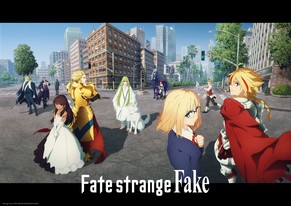
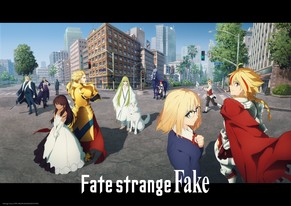
Fate/strange Fake – Episodes 1–4 preview screening image
Table of Contents
What Makes Fate/strange Fake Different: Synopsis & Setup
Set in the American city of Snowfield, Fate/strange Fake pits modern mages against mythic Servants in a Holy Grail War that’s both familiar and distorted. Six (supposedly) participating Masters summon legendary heroes, but this time the ritual was assembled from stolen, incomplete fragments of the Japanese original—resulting in something “strangely fake.” That premise allows the series to play with Fate conventions while delivering new emotional beats and conflicts. Instead of a neat tournament with clear rules, this war is messy, improvisational, and dangerously unpredictable.
Episodes 1–4: A First Act Built on Character and Collision
These initial episodes function as Act One: introductions, friction, and the first sparks of conflict. While there’s more combat than exposition, each clash reveals character. The pacing leans into skirmishes that double as character moments, and the narrative prioritizes relationships over exhaustive rule-explaining. The result is a brisk, engaging opening that hooks both longtime Fate fans and newcomers who want clear emotional stakes amid the spectacle.
Ayaka and Saber: A Master-Servant Relationship Upside-Down
The first episode centers on Ayaka, an outsider in a war designed for six mages. By her own admission she’s not a conventional mage, and her unwillingness to play the traditional Master role gives her dynamic scenes with her summoned Saber. Unlike standard power-driven Masters, Ayaka refuses to be a puppet—an attitude that endears her to Saber and gives their interactions a quieter, human warmth. Their relationship becomes a core source of levity and heart, balancing the series’ darker, more violent beats.
Tiné & Gilgamesh: Reframing an Icon
Another standout pairing is Tiné and Gilgamesh. Tiné enters the war to reclaim ancestral land on behalf of her people, but she lacks a personal wish. Gilgamesh responds by stepping away from his archetypal kingly or villainous mask and into the role of mentor and guardian. He pushes Tiné to think independently rather than act as a cultural pawn, even while pursuing his own desire—an intriguing, more humanized take on a character many viewers thought they already knew.
Non-Mages, Institutions, and a War That Breaks Rules
One of the more compelling shifts in this iteration is the degree to which ordinary people, police, and organizations are embroiled in the conflict. Unlike previous Holy Grail Wars—where the wider public is mostly oblivious—here non-Masters carry Noble Phantasms and actively disrupt the status quo. Orlando Reeve and other law enforcement figures find themselves in morally gray territory; the Church, tasked with neutrality, faces a dilemma when a vampire acts as a Master. Hansa Cervantes’ uncompromising stance on hunting supernatural threats highlights how institutional duty and personal vendetta collide.
Visuals, Direction, and Where the Series Shines
Visually, the series largely lives up to franchise expectations. The previewed episodes include moments of stunning animation—particularly in high-intensity action and key emotional beats—though episodes 2–4 occasionally dip from “excellent” to “great.” These fluctuations don’t undercut the overall presentation; rather, they underscore the challenge of maintaining peak animation across multiple episodes. Still, the design, choreography, and staging consistently deliver cinematic sequences that reward repeat viewing.
Hiroyuki Sawano’s Score: Soundtracking the Strange
The soundtrack remains one of the show’s strongest pillars. Hiroyuki Sawano’s compositions elevate both spectacle and intimacy—action sequences hit harder and quieter scenes land deeper thanks to his trademark orchestral and electronic blends. The only minor oddity is that the ending theme is not by Sawano, making it feel slightly out of tonal sync with the rest of the score; otherwise, the music is a near-perfect companion to the narrative.
Where This Arc Leaves Us and Why It Matters
The arc concludes on a twist that reframes the war and forces viewers to reconsider events that felt straightforward. That shift is precisely what makes Fate/strange Fake compelling: it can play within established Fate tropes while subverting them in ways that create fresh drama. Whether you’re deeply versed in Type-Moon lore or approaching the series cold, the emotional clarity of its lead characters keeps the story accessible.
Further Reading
For background on the author’s broader work, Ryohgo Narita’s storytelling style is explored in various profiles and can provide useful context for readers who enjoyed the pacing and ensemble interplay in these episodes. See his profile on Wikipedia for more. Ryohgo Narita — Wikipedia
If you’re interested in the soundtrack creator’s catalog and how his scoring approach shapes the series, check out references on Hiroyuki Sawano. Hiroyuki Sawano — Wikipedia
Final thoughts
Fate/strange Fake’s first four episodes deliver an exciting, character-rich opening to what promises to be a standout adaptation. Action, heart, and mystery are balanced in a way that honors the franchise while carving new narrative space. With memorable character dynamics, a superb score, and a story willing to break its own rules, this is one Holy Grail War that refuses to be predictable—exactly the kind of “strange” the title promises.