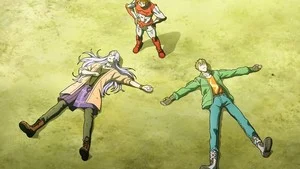
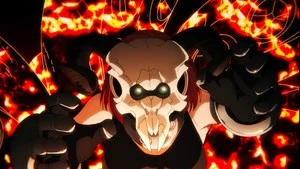
Dead Account’s fifth episode doubles down on everything that’s made this series divisive: awkward animation choices, a scattershot tone that flips between horror, comedy, and exposition, and a plot device that leans on social-media scares instead of a coherent supernatural logic. This installment brings Soji face-to-face with the malevolent “Sad Boy K,” but what should be tense and dramatic more often plays as unintentionally hilarious or painfully inert. Below I break down the episode’s strengths and shortcomings across animation, pacing, character work, and the show’s thematic ambitions.

Table of Contents
Animation and Art Direction: When Awkward Becomes the Main Attraction
If there’s a single visual moment that will be played back in viewers’ heads after Episode 5, it’s the painfully awkward frame of Soji lunging at Sad Boy K. The shot is so stiff and unnatural that it becomes the episode’s primary source of strange charm — not because it’s meant to be memorable, but because the animation quality is inconsistent to the point of being surreal. Character movement frequently feels disconnected from the camera framing: limbs swing, effects flash, and yet characters remain planted in space as if glued to the ground.
There are brief scenes where the animation improves — especially some of Azaki’s water-attack sequences — but these feel tacked on rather than indicative of a consistent production standard. The overall impression is of a show scrambling to sell action without committing to fluid choreography or convincing staging.
Pacing and Fight Choreography: Stuck in Place
The confrontation with Sad Boy K should read as an escalating threat, but his portrayal as a nearly motionless antagonist robs the fight of dynamism. Instead of a tense duel, we get a rhythmic exchange of attacks with little spatial movement or positional stakes. Azaki’s role in the skirmish underscores this problem: he hops around and belches out flashy water spells, yet rarely closes the distance to make the battle feel like a proper clash. Think of the early, turn-based aesthetic of classic JRPG combat — visually active, but emotionally static.
Compounding the problem is the episode’s interruption of action by lengthy dialogue — particularly Kiyomi’s monologues about Azaki’s history — which saps momentum at critical beats. Rather than using exposition to deepen the stakes, the series often pauses on filler conversations that feel like they belong in a character profile special rather than mid-battle.
Characterization: Sad Boy K and the Problem with “Menacing” Villains
Sad Boy K is presented as a chilling antagonist on paper: an entity linked to the deaths of those who follow his account. On-screen, however, he’s underwritten. His primary “attack” — inducing bleeding from opponents’ eyes — is visually unsettling, yet he lacks the active malevolence that makes a villain compelling. He stands, watches, and waits, which can be effective as sinister stoicism, but in Dead Account it reads more as passivity.
Soji, Kiyomi, and Kasubata continue to function as archetypal shonen protagonists, albeit ones hampered by weak dialogue and a script that struggles to balance humor with horror. Azaki’s brief backstory is a missed opportunity to layer in complexity; instead, it’s used to stall the episode and remind viewers that the series prefers exposition over meaningful character beats.
Humor and Tone: Attempts at Comedy That Don’t Land
Dead Account consistently flirts with comedy — sometimes intentionally absurd, sometimes unintentionally so. Episode 5 leans on an extended gyaru nurse bit that aims for slapstick and pop-culture referencing but mostly lands flat. The scene plays like shorthand for “weird adult humor,” tossing in anime-internal references and expecting laughs without providing a payoff.
The show’s tonal volatility — bouncing between supernatural tension, hokey humor, and pseudo-philosophical musings — makes it difficult to invest emotionally. Moments meant to instill dread get undercut by dated pop-culture winks or meta commentary that feels shoehorned into the script.
Thematic Ambitions: Social Media, the Dead Internet Theory, and Missed Depth
Episode 5 tries to weave social-media anxieties into its mythology, explicitly referencing followers as a mechanism of supernatural contagion. The script gestures at the Dead Internet Theory — the idea that much of online activity is automated or hollow — but treats the concept superficially. Instead of an incisive critique of digital life, the series offers a simplistic causal link: follow the account, and bad things happen.
Had the episode leaned into a more focused critique (or fully committed to mysticism as the source of its horror), the connection between technology and the supernatural could have felt earned. As it stands, the social-media angle reads like a veneer, an attempt to appear topical without grappling with the real implications of online influence and disinformation. For readers unfamiliar with the Dead Internet Theory, this explainer may provide context: Dead Internet Theory — Wikipedia.
Where Episode 5 Succeeds — and Where It Falls Short
Successes:
– A few striking frames and moments of unintentionally memorable animation that stick with the viewer.
– Occasional atmospheric sound design and visual effects that hint at the show’s intended mood.
Shortcomings:
– Inconsistent animation quality and static fight staging.
– Weak villain characterization and interrupted pacing.
– Humor and exposition that dilute rather than deepen tension.
How to Watch
Dead Account is available for streaming; check the official distributor’s page for availability in your region. For example, the series can be streamed on Crunchyroll here: Dead Account on Crunchyroll.
Final thoughts
Episode 5 of Dead Account is a mixed bag that leans toward disappointment. Its best moments are often accidental — an awkward frame that becomes memorably bizarre, or a briefly improved action sequence — while its core problems (stilted animation, weak pacing, and shallow thematic treatment) remain. The show’s flirtation with social-media horror has potential, but until the writing commits to a clearer tone and the production stabilizes its animation, Dead Account will continue to feel like a series of promising ideas hampered by inconsistent execution. If you’re watching for novelty, this episode offers spectacle of a strange sort; if you want coherent scares or sharp satire, you may want to wait and see whether the series finds its footing.