Scarlet arrives as Mamoru Hosoda’s latest attempt to rework classic English literature through an anime lens: a revenge-driven reimagining of Hamlet that sends its protagonist beyond life into a shared afterlife called the Otherworld. The film sets up a promising premise — a princess bent on avenging her father and an unlikely modern-day companion who challenges her assumptions — but it struggles to hold together across screenplay, pacing, and animation choices. Below I break down what works, what doesn’t, and why Scarlet lands as one of Hosoda’s more uneven outings.
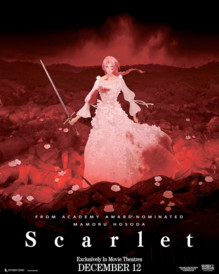
Scarlet — a Hamletic anime voyage into the Otherworld.
Table of Contents
Synopsis: Revenge, the Otherworld, and a Modern Conscience
Scarlet follows the titular Princess of Denmark on a mission to avenge her father, Amleth, by killing her treacherous uncle Claudius. When her mortal quest fails, Scarlet’s journey continues into the Otherworld — a desert-like afterlife populated by souls from across eras and nations. Claudius has consolidated power there, promising ascension to loyal followers. Scarlet’s path runs alongside Hijiri, a present-day Japanese nurse whose pacifist worldview clashes with Scarlet’s thirst for vengeance and forces the film to wrestle (sometimes clumsily) with questions about violence and redemption.
Direction and Screenplay: Great Ideas, Fraught Execution
Mamoru Hosoda brings his signature ambition: big emotional stakes, imaginative worldbuilding, and an attempt to graft contemporary ethical concerns onto a classic story. But Scarlet’s screenplay often feels unfocused. The central moral tension — revenge versus pacifism — should be compelling, yet it’s handled with blunt, repetitive dialogue that fails to deepen either character. Hijiri’s pacifism, which could have provided interesting counterpoint and nuance, remains underexplored, and his emotional arc feels peripheral rather than essential.
When Adaptation Meets Didacticism
Reworking Hamlet into an afterlife odyssey is a brave creative move, but the film’s tone drifts into didactic territory. The ending aims for sweeping moral closure but lands as simplistic and overly earnest, undermining some of the earlier intrigue. Hosoda’s intent — to use a personal, literary narrative to comment on larger conflicts — is clear, but conviction and narrative tightness are what the film lacks.
Animation and Visuals: Peaks and Troubling Valleys
Visually, Scarlet is a mixed bag. The hand-drawn opening in Elsinore and some of the Otherworld vistas reveal the director’s eye for composition and atmosphere. At moments the film genuinely captures the kind of emotional visual poetry Hosoda is known for.
Where the Animation Falters
Unfortunately, inconsistency becomes a recurring problem. The blend of 2D and 3D is uneven: some scenes feel richly detailed, while others suffer from awkward frame rates and poorly integrated crowds. Two dance sequences are particularly problematic — one comes off as stiff and low-framerate, while a large-scale La La Land–inspired fantasy number collapses under the weight of hundreds of badly animated extras and frenetic 3D camera work. These sequences should soar, but instead they break the film’s immersion.
Characters and Performances
Scarlet herself is compelling in concept: a grief-forged force of will whose moral choices should make for fascinating drama. In practice, though, the film doesn’t give enough texture to the people around her. Hijiri, intended as the emotional core of the film’s conscience, too often reads as flat and underwritten. Secondary characters and crowds mostly exist as atmosphere rather than true dramatic catalysts, which saps much of the narrative momentum.
Supporting Cast and Worldbuilding
The Otherworld is rich in idea — a cross-cultural purgatory where different eras collide — yet the film underutilizes the potential for distinct supporting figures. With a more robust ensemble the journey could have generated richer stakes and clearer thematic contrasts.
Thematic Intentions and Comparisons to Hosoda’s Oeuvre
Hosoda’s best films — The Girl Who Leapt Through Time, Summer Wars, Wolf Children — paired emotionally resonant scripts with visual inventiveness. Scarlet feels like a step away from that balance: the concept is boldly ethical and topical, but the execution gives us Hosoda’s ambition without his usual narrative precision.
Fans of Hosoda will recognize recurring preoccupations: family, memory, and the consequences of technological or metaphysical dislocation. That heritage is present here, but the film’s weaker script and puzzling animation choices prevent it from joining his stronger works.
Context: Festivals and Creative Collaborations
Scarlet’s screening alongside other contemporary films highlights an important point: a successful anime often needs a strong, complementary screenwriter-director partnership. Previous collaborations between Hosoda and screenwriter Satoko Okudera produced some of his highest highs; when the creative chemistry is absent or frayed, the film’s core can falter. The contrast between Scarlet and other recent festival titles shows how crucial script discipline and character complexity remain for storytelling that wants to reach beyond spectacle.
For further reading on film festival coverage and modern anime releases, check the TIFF site for program listings and notes. Toronto International Film Festival — official site.
Who Will Enjoy Scarlet?
If you come to Scarlet as a Hosoda completist or as someone who appreciates ambitious reinterpretations of classic texts, you’ll find moments of real beauty and provocative ideas worth discussing. But if you expect the tight emotional clarity and consistently excellent animation of his best work, Scarlet may feel disappointing. It’s a film of ideas more than execution — admirable in its reach, uneven in its grasp.
Final thoughts
Scarlet is an ambitious, imperfect entry in Mamoru Hosoda’s filmography. Its premise — an afterlife Hamlet with a modern pacifist counterpart — promises deep moral inquiry but doesn’t quite deliver the nuance or animation consistency the material demands. There are striking set pieces and sincere intentions here, but also clumsy dialogue, uneven character work, and sequences that undermine rather than elevate the film’s impact. Fans and critics alike will find plenty to debate; whether Scarlet becomes a misstep or a provocative experiment depends on what you value most in Hosoda’s films: raw ambition or refined storytelling.