The Japanese Ministry of Economy, Trade and Industry (METI) has laid out an ambitious roadmap to grow Japan’s creative exports — with the anime industry front and center. At its 18th Entertainment and Creative Industrial Policy Seminar held on March 27, METI announced concrete measures aimed at reaching a combined 20 trillion yen overseas market for Japan’s creative industries by 2033. For anime creators, studios, distributors and international partners, the plan signals both opportunity and pressure: scale-up production, strengthen distribution and clamp down on piracy while improving compensation models for creative workers.
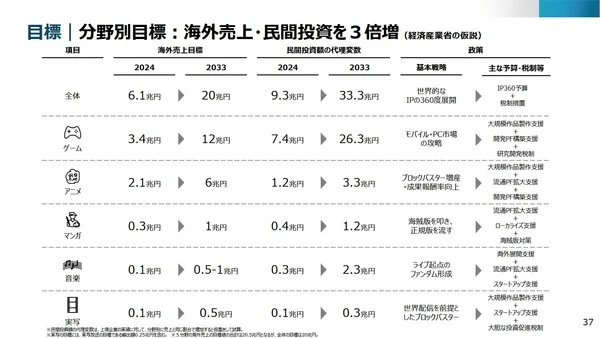
Table of Contents
METI’s 2033 Strategy for the Anime Industry
METI’s policy places clear emphasis on three pillars to turbocharge anime’s overseas growth: (1) production of large-scale “blockbuster” titles, (2) expansion and diversification of global distribution platforms, and (3) the buildout of development platforms and production capacity. Alongside these, the government singled out improving performance-based pay to make creative careers more sustainable and attractive.
Producing Blockbusters at Scale
To capture larger shares of global streaming, theatrical and licensing revenues, METI recommends prioritizing investments that enable studios to create tentpole IP — projects with international marketing appeal and strong merchandise potential. This implies more co-productions, bigger budgets for animation pipelines, and strategic IP management to maximize ancillary sales.
Distribution and Development Platforms
METI plans to funnel support toward expanding distribution channels — including partnerships with global streaming services and localized storefronts — while also investing in development platforms that lower the barrier for studios to produce and manage large-scale releases. The goal is a robust end-to-end ecosystem: ideation, production, distribution and monetization.
Worker Compensation and Performance-Based Pay
One notable policy focus is raising the rate of performance-based pay for anime workers. METI recognizes that talent retention and fair compensation are critical to sustainable growth; policies and funding schemes are expected to encourage remuneration tied to a work’s commercial success.
Key Market Numbers and Trends (2024 Snapshot)
METI’s analysis paints a bullish near-term picture for anime’s global footprint. In 2024 the global anime market reached a record 3.8407 trillion yen (~US$25.1 billion), split into a 2.1702 trillion yen overseas market and a 1.6705 trillion yen domestic market. Overall growth for 2024 was +14.8% year-over-year — led by a +26% expansion in overseas revenue compared with only +2.8% domestically. Notably, 2024 marked the third consecutive year in which the overseas market outpaced the domestic market, reinforcing the logic behind METI’s export-oriented strategy.
Complementary Targets: Games and Manga
METI’s 2033 ambition extends beyond anime. The plan targets the game industry to grow from 3.4 trillion yen to 12 trillion yen overseas, emphasizing large-scale releases, development platforms and R&D tax incentives. For manga, the goal is to lift overseas revenue from 300 billion yen to 1 trillion yen by strengthening distribution platforms, localization and anti-piracy measures. Combined, METI expects anime and games to account for roughly 18 trillion yen of the 20 trillion-yen target.
What This Means for Studios, Creators and International Partners
Opportunities
- More public funding and incentives for high-budget projects and international co-productions.
- Greater emphasis on IP strategy — licensing, merchandising and transmedia expansion will become core business activities.
- Increased demand for localization teams, international marketing specialists and platform partnerships.
Challenges
- Pressure to scale quickly could favor larger studios and well-funded projects, risking reduced visibility for indie creators.
- Effectively raising worker pay while scaling production costs requires careful fiscal design and sustainable revenue-sharing models.
- Anti-piracy enforcement and cross-border rights management remain technically and legally complex.
Practical Recommendations for Industry Stakeholders
For Studios
Prioritize IP portfolios that can be translated across formats (anime, games, manga, live events). Invest in infrastructure and cloud-based pipelines that enable scalable production without sacrificing quality. Explore co-production treaties and joint ventures to spread risk and access foreign markets.
For Creators and Talent
Negotiate for clearer performance-based compensation tied to global revenue streams. Gain skills in cross-cultural storytelling and collaboration tools to become more competitive for international projects. Consider forming or joining collectives to improve negotiating power for royalties and licensing.
For Distributors and Platforms
Accelerate localization and subtitle/dub quality to capture regional audiences. Implement robust geo-aware anti-piracy and takedown strategies while offering affordable licensed alternatives to convert illegal viewers into paying customers.
Further Reading
For more detail, see METI’s briefing document (PDF) outlining the Entertainment and Creative Industrial Policy Seminar. The METI document provides the official breakdown of targets and priorities. Read the METI PDF. Additional industry analysis appeared in trade coverage summarizing the market figures and implications. Industry commentary and data.
Final thoughts
METI’s 2033 blueprint is a clear signal: Japan intends to double down on creative exports by scaling production, professionalizing distribution, and making creative careers more sustainable. For anime, the coming decade will be about balancing blockbuster ambitions with diverse creative voices. Success will depend on coordinated public funding, smart private investment, stronger copyright enforcement, and fairer compensation structures that keep talent at home while making Japanese IP more resonant worldwide.