Table of Contents
Edge of Time Review: Beautiful Moments, A Fractured Whole
Edge of Time is an ambitious four-part anthology that pairs Japanese and Chinese directors in a meditation on love, loss, and the human cost of war. With segments from Shinichirō Watanabe and Shuhei Morita alongside Chinese filmmakers Li Wei and Weng Ming, the film offers vibrant visuals and standout moments — yet struggles to cohere into a satisfying single experience. Below I break down the film’s strengths, its most memorable shorts, and where the anthology’s connective tissue fails to hold.
Synopsis — Souls Across Time
Across four distinct vignettes, Edge of Time follows two souls reaching for one another through different eras and realities. The shorts vary wildly in tone and setting: underwater fantasy, a feudal war parable, a retro-cyberpunk drama, and a post-apocalyptic road tale. Attempts to bind these pieces together — through recurring symbols like roses and a recurring robot — ultimately feel superficial, leaving the viewer with a collection of very different films rather than a single unified narrative.
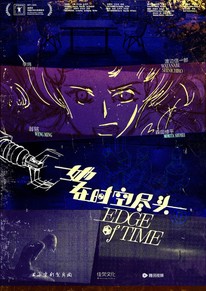
Edge of Time — anthology from multiple directors exploring love across conflict.
Anthology Structure & Thematic Intent
The film tries to create an overarching frame — brief black-screen narrations from a character in the opening short attempt to comment on the subsequent tales — but those interludes only emphasize the mismatch between segments. Shared motifs (a white and red rose, a distinctive robot) pop up, but their meanings shift from vignette to vignette. The only recurring theme that emerges clearly is the anti-war message: each story, in its own way, suggests that nobody truly wins when conflict spirals out of control. Unfortunately, the message is often surface-level, and the anthology never digs deep enough to form a satisfying thematic throughline.
Standout Shorts: Highlights and Misses
The Underwater Girl — Visual Whimsy That Tests Patience
The opening short drifts into poetic imagery: a girl dives after a discarded toy into a surreal ocean where toys are massive and time feels elastic. While the underwater sequences are visually striking and atmospheric, the segment leans heavily on shot-after-shot whimsy without clear narrative purpose. Too much of its runtime is dedicated to atmosphere rather than plot or character development, leaving the sequence feeling self-indulgent and, at times, dull.
Roots (Shuhei Morita) — War, Memory, and a Clever Twist
Morita’s short centers on two friends who communicate through a pair of red and white flowers while unknowingly on opposite sides of a prolonged conflict. The vignette functions as a commentary on cycles of retaliation and inherited hatred, and it benefits from bold creature and battle designs — aesthetic choices that lend weight to its feudal-inspired skirmishes. While somewhat predictable, Roots introduces a twist that adds texture even if it doesn’t fully transform the story.
Retro-Cyberpunk Gem — The Best of the Bunch
The third vignette is the anthology’s high point: a gorgeously animated cyberpunk drama set in a 1930s China-inspired metropolis. It follows a filmmaker who clings to movies as an escape after losing his love. As tensions rise between humans and cyborgs, the protagonist remains trapped in self-deception, using art to avoid confronting reality. This segment excels thematically and visually — the worldbuilding is imaginative, the animation stellar, and the emotional stakes land in ways other shorts do not. If you see only one reason to watch the film, this is it.
A Girl Meets a Boy and a Robot (Watanabe) — Emotion and Confusion
Watanabe’s closing piece pairs post-apocalyptic landscapes with poignant character beats: the last girl on Earth searches for survivors and finds unexpected companionship in a robot and a young man. The short offers effective action and a heartfelt anti-war core, but it’s thematically muddled by a supernatural twist that raises more questions than it answers. Emotionally resonant in key moments, it still struggles to reconcile its ideas into a coherent whole.
Animation, Style, and Technical Notes
Across the anthology, animation quality varies but frequently shines — especially in the cyberpunk piece, where character animation and environmental design are exceptional. Battle choreography in Roots and the final segment’s action sequences deliver kinetic energy. However, inconsistent pacing and uneven storytelling choices keep the film from reaching its full potential.
Where Edge of Time Stumbles
The fundamental issue isn’t that the film’s shorts are bad — several could stand alone as feature-length projects or even series — but that they were shoehorned into a forced anthology. The connective narration and recurring symbols feel retrofitted rather than organic. Instead of complementing one another, the segments sometimes undercut each other’s emotional impact when viewed back-to-back.
Who Should Watch This Film?
If you’re a fan of ambitious animation anthologies or directors like Shinichirō Watanabe, there are moments here worth experiencing. Viewers seeking a tightly woven anthology may be disappointed, but those who appreciate striking visuals, a brilliant cyberpunk vignette, and thematic exploration of war and memory will find value.
For more background on the directors and their other works, see the director pages (nofollow): Shinichirō Watanabe and Shuhei Morita.
Final thoughts
Edge of Time is a visually compelling anthology that contains sparks of greatness but ultimately feels like four promising short films that were never meant to be forced into one single narrative. The third vignette alone justifies a viewing, and other segments offer moments of beauty and pathos. Still, the anthology’s inconsistent pacing, the weak opening short, and the superficial attempts at unity prevent it from becoming the cohesive work it aims to be. Watch it for the animation and individual stories — but don’t expect a fully unified cinematic experience.