Romeo’s Blue Skies is a powerful entry in the World Masterpiece Theater tradition — a heartbreaking, earnest adaptation of Lisa Tetzner and Kurt Held’s 1941 novel that reframes 19th-century hardship through the eyes of a young Swiss boy. This review explores why the series remains memorable decades after its release: its themes of friendship and survival, its difficult but meaningful emotional beats, and how the anime both honors and reshapes its source material to reach a new generation of viewers.
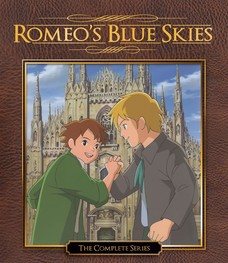
Romeo’s Blue Skies – the World Masterpiece Theater adaptation of Die Schwarzen Brüder.
Table of Contents
Synopsis: A Grim Childhood and a Bright Friendship
Set in the late 19th century, Romeo’s Blue Skies follows Romeo, a poor mountain boy whose life unravels when the slaver-like Luini burns his family’s fields and forces him to sell himself as a chimney sweep. Transported to Milan and sold to the cruel Rossi household, Romeo’s new life is one of labor and abuse. The emotional core of the story, however, is his bond with Alfredo — another boy who, like Romeo, has sacrificed himself for family. Their relationship becomes the series’ guiding light, giving Romeo purpose and a reason to dream of a kinder world.
Why the Series Resonates: Themes That Matter
Friendship as Salvation
The bond between Romeo and Alfredo is the emotional engine of the narrative. The series handles their connection with tenderness and clarity: Alfredo’s protective, deeply affectionate behavior toward Romeo reads as a devotion that lifts the young protagonist out of despair. The friendship is depicted as both emotionally intimate and morally formative, teaching Romeo resilience, literacy, and the belief that life can be better.
Hardship, Injustice, and Moral Purpose
Romeo’s Blue Skies doesn’t shy away from cruelty. The show lays bare the brutal realities faced by child laborers — disease, exploitation, and arbitrary fate. But the point of the suffering is explicit: it’s not suffering for its own sake. The narrative emphasizes obligation to those who didn’t survive and a duty to build a fairer world. Symbolism is sometimes overt (paper doves and repetitive visual motifs), but the clarity helps deliver the series’ moral message without diluting its emotional weight.
Adaptation Choices: From Novel to Anime
While the anime makes changes — most notably renaming Giorgio to Romeo and adding anime-original elements — it preserves the novel’s heart. Certain characters, like Angeletta, are expanded in the adaptation to create contrasts and parallels that accentuate the themes of randomness and mercy. Where the book provided a framework, the anime broadens the interpersonal dynamics and heightens drama to better suit serialized television storytelling.
Faithful Spirit, Creative Interpretation
The adaptation respects the original novel’s intention: to show that even when terrible things happen, survival and compassion are possible and worth fighting for. Scenes that are anime-only still contribute meaningfully to that message, shaping viewer empathy and reinforcing the series’ central thesis.
Characters That Stay with You
Romeo’s quiet resilience and Alfredo’s moral clarity are the series’ greatest strengths. Their dynamic is not only the emotional core but also the moral compass: Alfredo’s influence turns Romeo from a frightened child into a lifelong advocate for kindness. Secondary characters — the vicious Luini, the oppressive Rossi family, and survivors like Angeletta — provide texture and stakes, illustrating a spectrum of outcomes for children of that era.
Visuals, Sound, and Period Detail
The production occasionally stumbles visually, but the series often gets the atmosphere and period detail right — from dingy Milanese streets to the austere mountain life Romeo leaves behind. The anime’s use of Italian language cues (written and spoken) and a haunting opening theme bolster its authenticity and emotional resonance. Sound design and music underscore the most significant scenes, making the series’ highs and lows land with sincerity.
Historical Context and Real-World Parallels
Although set in the 1870s, the show’s origin in a wartime novel gives it an almost allegorical weight: authors Tetzner and Held originally wrote to communicate resilience during dark times. That historical layer deepens the anime’s message — the hardships depicted are both period-specific and universally resonant. For readers interested in the real-life conditions of chimney sweeps, this Wikipedia overview provides historical context.
Where to Read the Original and Further Resources
If you’re curious about the novel that inspired the series, an English translation is available and offers additional perspective on the source material: Die Schwarzen Brüder / The Black Brothers (archive.org). The book frames the same moral core in a different style, and reading it alongside the anime highlights the adaptation’s creative choices.
Who Should Watch Romeo’s Blue Skies?
Fans of emotionally-driven historical drama and character-focused storytelling will find much to appreciate. Be mindful that the series contains difficult subject matter and bleak scenes — it’s not light viewing — but its ultimate message of hope and moral responsibility makes it a rewarding experience for mature viewers who can handle its darker moments.
Final Thoughts
Romeo’s Blue Skies is a bittersweet, earnest work that balances unflinching depictions of child hardship with a hopeful belief in human compassion. Its central relationship — the protective, heartbreaking friendship between Romeo and Alfredo — elevates the series above mere historical melodrama into something genuinely affecting. Imperfect in places, the anime nevertheless succeeds at conveying a timeless message: terrible things can be endured, and those who survive have a duty to make the world kinder for others.